Justin Bower
Wise Bloody Study
oil on canvas
130 × 120 cm / 51.2 × 47.2 in (height × width)

Ornament & the painted body / Justin Bower
Justin BowerWise Bloody Study
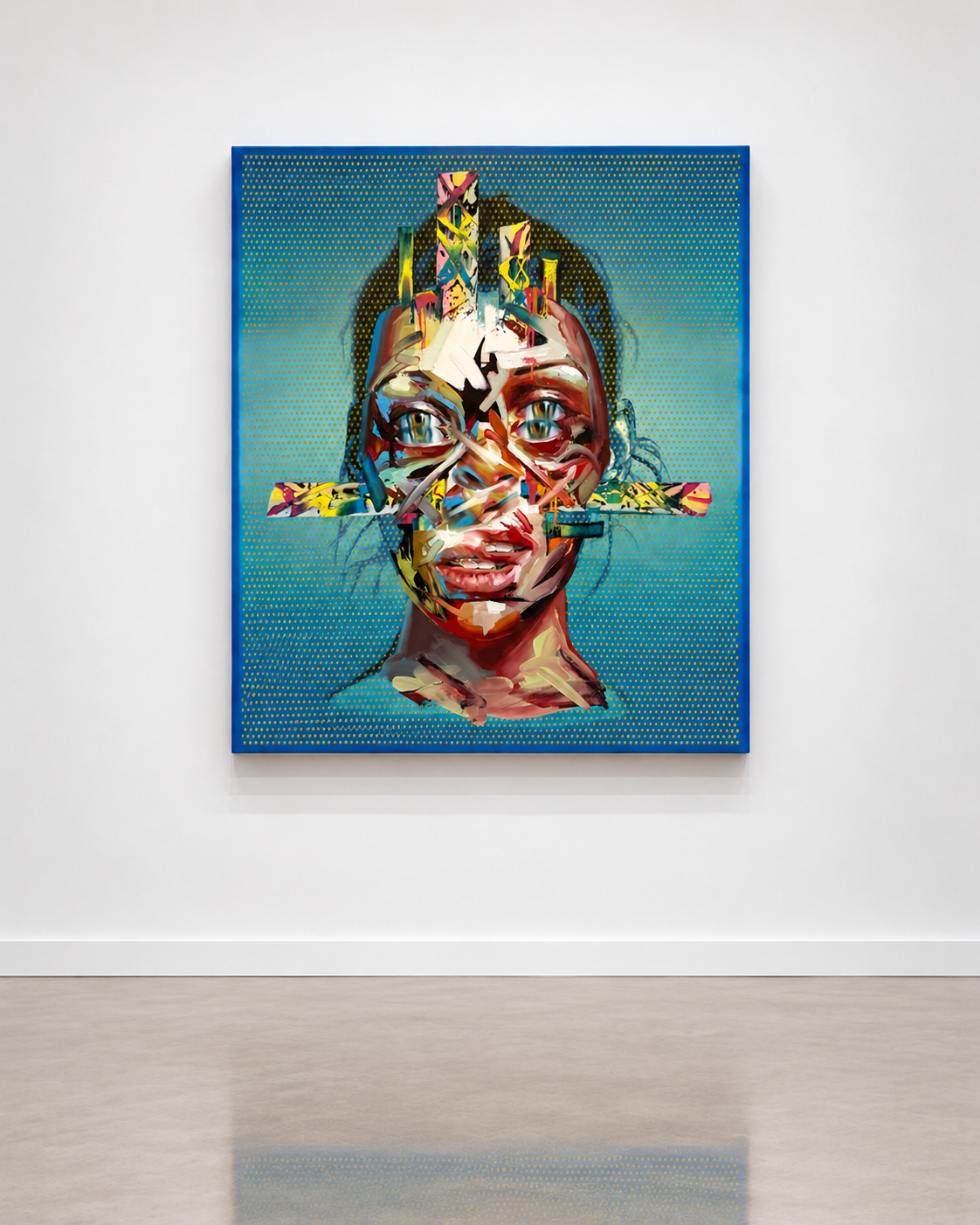
Small yellow crosses spread across a blue field, meeting a face built from sweeping, overlapping passages of paint. In Wise Bloody Study, ornament becomes an active part of the portrait.
- Medium
- Oil on canvas
- Dimensions
- 130 × 120 cm
51.2 × 47.2 in · Height × width - Availability
- Price and current status confirmed on enquiry
Contact G-ALLERY for the current price and work-specific documentation.
Discover the role of ornament01 / Ornament & embodiment
The ground
takes a part.
A curatorial reading by G-ALLERY
In Wise Bloody Study, the space around the head has its own insistent character. Rows of small yellow crosses extend over a blue field, covering the canvas with a closely spaced pattern. They remain visible across parts of the dark silhouette behind the face. The setting is therefore neither empty nor entirely separate from the body it surrounds.
Against this field, the face is formed through a different vocabulary of marks. Broad sweeps describe the cheeks and neck; angular slivers cross the nose; creamy passages accumulate above the eyes. The small repeated unit and the expansive brushstroke establish two distinct ways of organising a painted surface. Their encounter gives the work its particular density.
Ornament as structure
Pattern is often treated as a secondary element in a portrait: a textile, wallpaper or decorative accessory accompanying the sitter. Here it occupies the image as a whole. No depicted fabric explains the crosses, and no room fixes their location. They become a structural presence, determining how the head is set into the field and how its perimeter can be followed.
The crosses can evoke the counted marks of stitching or a patterned screen, without resolving into either material. This ambiguity matters. A familiar decorative unit acquires a new function when carried into a painting of flesh. It can link distant areas of the canvas, continue across a silhouette and interrupt the separation between subject and setting.
The expressive work of decoration
The painting offers a way to reconsider the distinction between ornament and expression. Decoration is frequently assigned the role of embellishing a surface already understood; here the pattern helps establish what that surface can mean. The portrait’s emotional register belongs not only to the eyes and mouth, but also to the cool blue field and the yellow marks surrounding them.
Read in the context of contemporary visual design, where modular patterns recur across interfaces, textiles and printed surfaces, the work brings a widely shared graphic language into contact with the particularity of painted flesh. The patterned field offers consistency. The facial passages introduce weight, pressure and directional changes that resist being reduced to an equivalent unit.
The word Study in the title can invite close attention to this conjunction. Rather than assuming a preparatory relationship to another painting, the work can be approached through the sustained pictorial question visible here: how can a repeated sign and a bodily image occupy the same canvas without becoming interchangeable?
02 / The material mark
A ridge of paint.
A field of crosses.
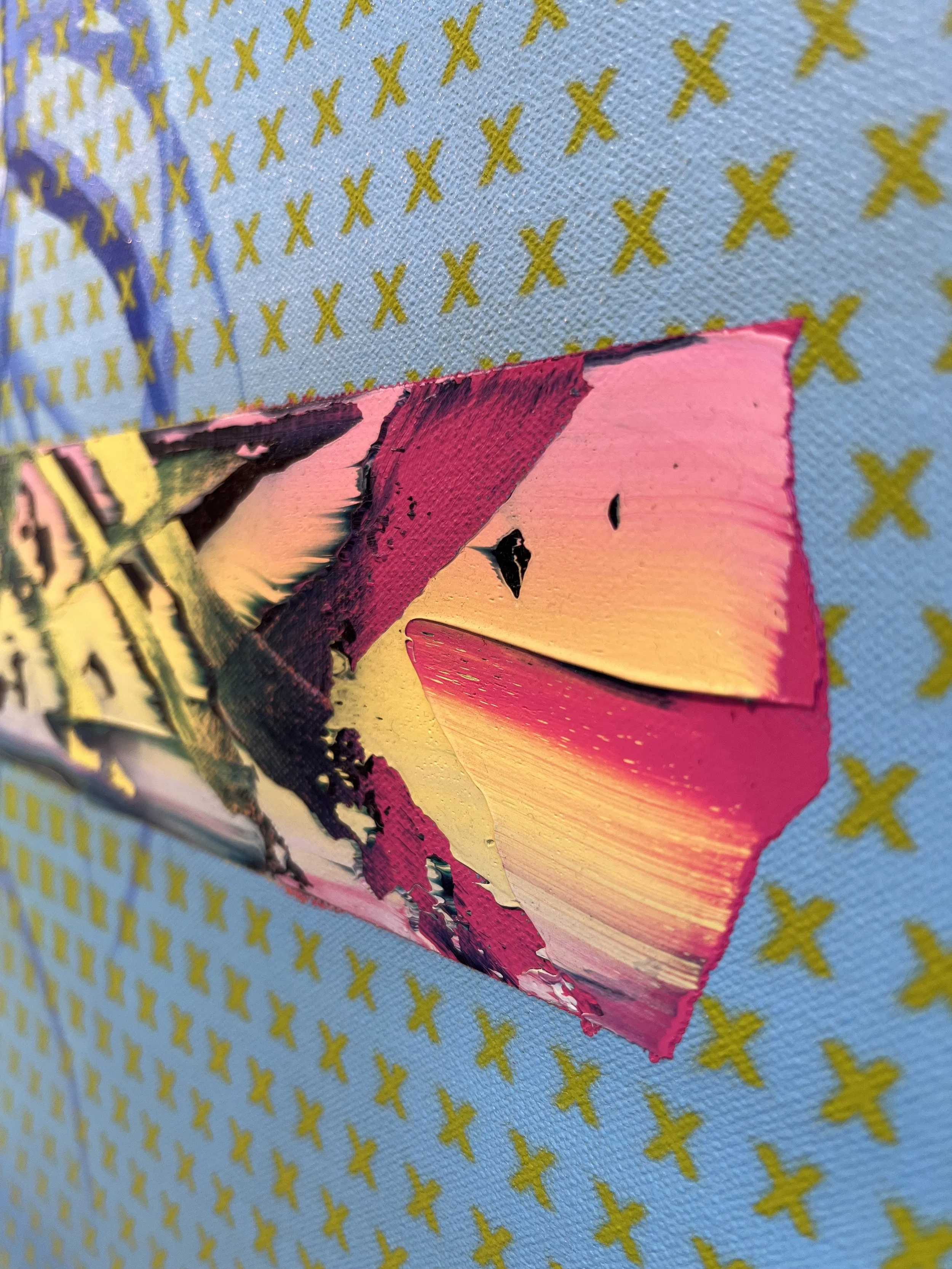
Seen at an angle, the horizontal strip extending from the face reveals a physical edge. Pink and yellow paint gathers into ridges, with darker passages exposed between the strokes. The blue field beside it allows the weave of the canvas to remain perceptible.
This photograph gives a material distinction to what appears, from farther away, as a graphic arrangement. The strip has thickness and directional handling; the small crosses establish a more dispersed presence across the support. Both belong to the same painted object.
The oblique viewpoint is useful for examining surface relief; it does not represent the proportions of the complete composition.
03 / Reading the contour
An ear drawn
through the pattern.
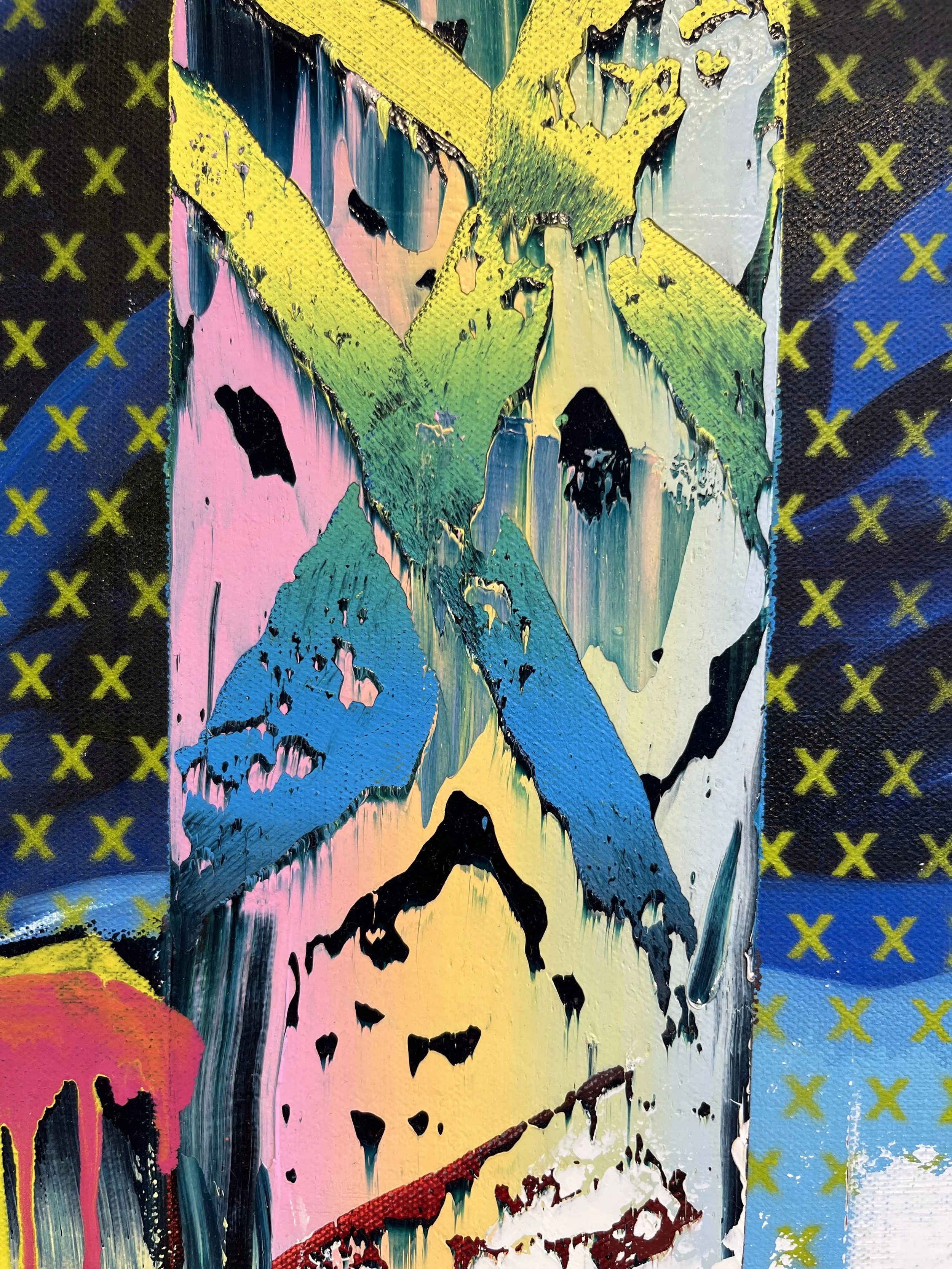
At the right-hand edge of the head, a thin blue contour describes an ear within the patterned field. Unlike the substantial strokes modelling the cheek, this line leaves the yellow crosses visible around and within its path.
The close view separates three treatments that a smaller reproduction can compress: the drawn outline, the repeated mark and the modelled flesh. Their meeting makes the perimeter of the portrait a place of exchange. The ear belongs to the head while retaining the visual character of the surrounding blue.

04 / Enquiries & viewing
From the image
to the object.
To consider Wise Bloody Study for a collection, begin with the aspects that photographs can only partly convey: the scale of the repeated marks, the relief of the paint and the colour of the blue field in the intended setting.
Request information on this paintingart@g-allery.com
Viewing the surface
Ask the gallery about the painting’s present location and available viewing arrangements. The two detail photographs on this page offer different evidence: one records the surface obliquely; the other shows the relationship between the pattern and the face.
Assessing its proportions
At 130 cm high by 120 cm wide, the canvas is close to square. Share the dimensions of a proposed wall to discuss placement, and confirm the overall installed measurements before planning a hanging.
Confirming acquisition details
Request the current price, availability and accompanying documentation for Wise Bloody Study. G-ALLERY can clarify the available condition and provenance information, together with delivery arrangements for your destination.
Further reading
The artist’s perspective.
Read Justin Bower’s conversation with G-ALLERY alongside this close study of the painting, or explore the broader selection of works on his artist page.
In conversation with Justin BowerVisit the artist page
Continue looking
Echo.
Explore Echo, another painting in the current Justin Bower selection, through its individual work page.
Discover EchoReturn to available paintings