
This weekend marked the 31st anniversary of Francis Bacon’s death—reason enough for us to take a closer look at this exceptional artist and his influence on contemporary art. Francis Bacon (1909–1992) is regarded as one of the most significant figurative painters, whose works hold a major place in the art history of the 20th century.
Bacon developed a distinctive visual language rooted in the distortion and fragmentation of the human body, characterised by an intensely expressive mode of painting. His canvases often depict solitary figures afflicted by strong emotions and existential anxieties, engaging with themes such as death, sexuality, violence, and isolation. He frequently drew on religious or mythological motifs, using them to introduce a profound symbolic dimension into his images. His triptychs—three-panel compositions—are particularly well known and often carry religious undertones. One example is “Triptych Inspired by the Oresteia of Aeschylus” (1981). Here, Bacon draws on Aeschylus’ ancient Greek tragedy The Oresteia, presenting three figures situated within a dramatic, chaotic context, and painterly intensifying the sense of threat generated by the depicted suffering and despair. This triptych exemplifies Bacon’s affinity for complex, surreal scenarios that can appear disorienting at first glance. It demonstrates his ability to transform mythological and literary subject matter into uniquely contemporary works of art. The use of strong contrasts and intense colours creates an emotional impact that holds the viewer in its grip. It is a masterpiece of figurative painting, revealing Bacon’s capacity to interpret existential themes with remarkable force.
By breaking the prevailing boundaries of figurative painting, addressing existential questions, and developing an unmistakably expressive style, Francis Bacon became one of the most influential contemporary artists. This iconographic legacy continues to resonate into the present and can be traced, not least, in the paintings of Justin Bower.
Bacon and Bower both approach the human portrait in a singular, nonconformist way, pushing beyond the limits of conventional portraiture. Bacon is known for expressive painterly gestures that distort and deform the body, eliciting a powerful emotional response. In a related way, Bower employs new techniques to depict the portrait as a distorted, fragmented construction—one that challenges human identity and engages with questions of technological progress, identity, and intimacy.
Both artists use portraiture as a medium through which to probe the human psyche and move toward its most interior dimensions. Bacon surrounds his figures with an unsettling atmosphere in which the inner life of the subject is revealed through the distortion of external form. Bower, by contrast, uses an expressive brushwork and heavy application of paint to articulate the complexity of the human self and to examine the fragmented nature of identity today.
Bacon and Bower are artists who, through innovative techniques and approaches, treat portraiture as a means of exploring human nature and its layered identities—an approach that feels timeless, and whose relevance persists alongside the evolution of humanity and its surroundings.
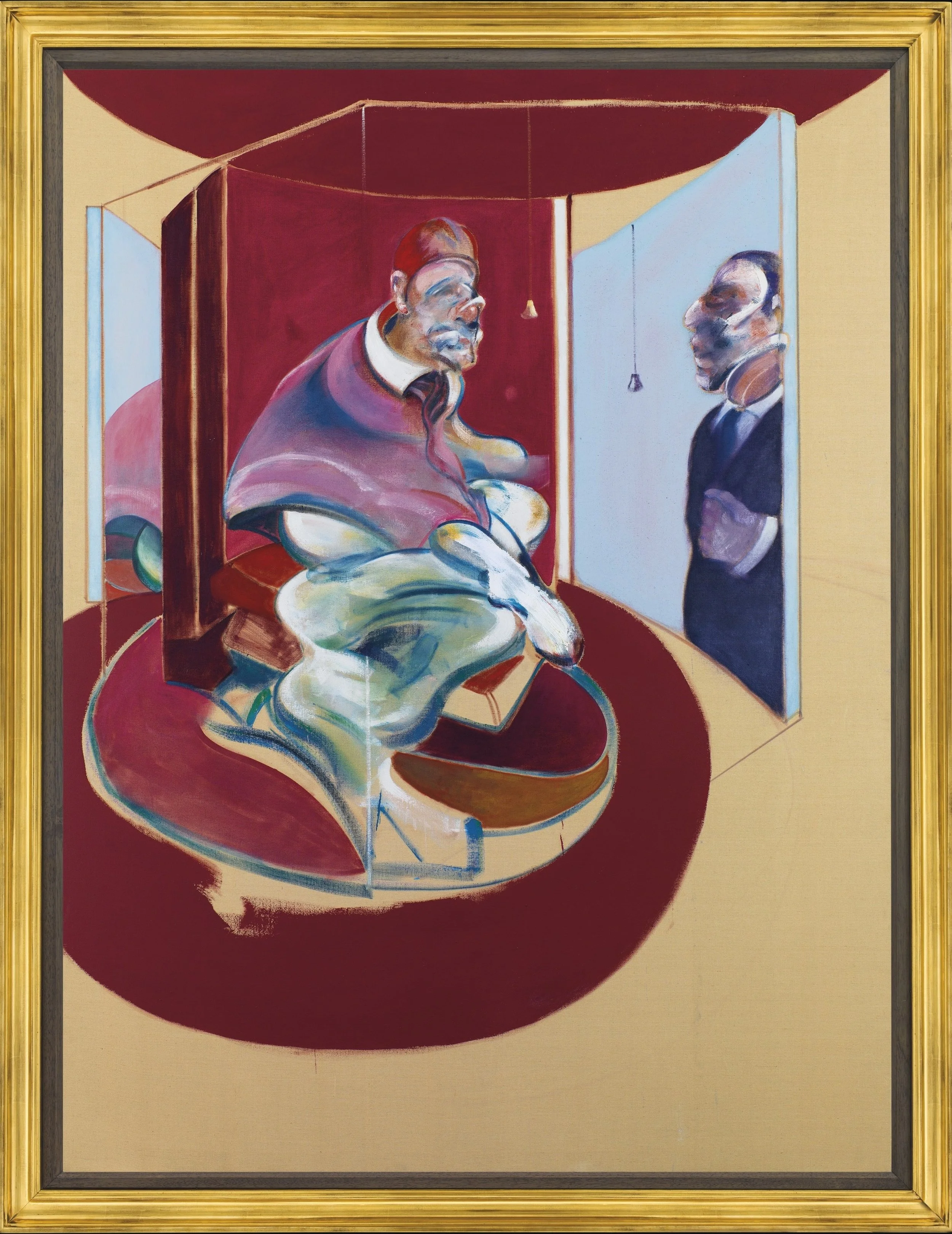


Images: (1) Francis Bacon “Study of Red Pope”, 198x147,5cm, Öl auf Leinwand, 1962, CR 71-04. (2) Francos Bacon “Portrait of George Dryer Talking”, 198x147,43cm, Öl auf Leinwand, 1966, CR 66-09. (3) Francis Bacon “Three Studies of Lucian Freud” (1/3), 198x147cm, Öl auf Leinwand, CR 69-07. (4) Justin Bower “Triptych” (2/3), 214x183cm, Öl auf Leinwand, 2022. (5) Justin Bower “Suspended Rapture”, 440x183cm, Öl auf Leinwand, 2022. (6) Justin Bower “Embryonic Love”, 214x183cm, Öl auf Leinwand, 2023.