
John Millei: Feelings Are Like Water
With the series “Feelings Are Like Water,” John Millei deepens one of the central questions of his painterly oeuvre: how can inner states be made visible without fixing them—without narrating, explaining, or illustrating? In these works, the sea no longer appears as a landscape motif or an external realm of experience, but as a metaphorical structure: a visual analogue for emotional fluidity, psychological transitions, and temporal continuity. Here, water is not a subject in the classical sense, but a mode of thinking. Feelings, as the title suggests, are like water: flowing, mutable, never fully controllable. They arise, condense, dissolve, and return in altered form. Millei translates these qualities into a painterly language that deliberately resists dramatic climax, instead privileging rhythm, repetition, and subtle variation.
In his earlier Surfer cycle, Millei engaged the sea as a site of physical experience—a space of corporeality, balance, and risk. The human figure was part of the pictorial logic, explicitly or implicitly present in relation to nature. In “Feelings Are Like Water,” that figure has disappeared entirely. What remains is movement itself. This absence does not signal loss, but a shift: the sea becomes an inner landscape, a projection surface for emotional states. The wave no longer reads as a dramatic peak or eruptive event, but as a rhythmic element—continuous motion without a narrative point of culmination. In this de-dramatization lies a decisive conceptual transformation. Millei’s paintings do not tell stories; they generate resonance.
Formally, the works are defined by a reduced yet highly sensitive visual language. Muted blues, greys, and whites dominate the picture plane, complemented by finely modulated transitions and visible brushwork. Paint is layered—at times transparent, at times materially dense—so that the process of making remains legible. This painting oscillates between control and release, between deliberate placement and intuitive gesture. Time is not depicted here; it is made palpable. The repetition of related forms, the minimal shifts within the rhythm of the waves, and the nuanced tonalities create a simultaneous perception of duration and change. The image becomes a place to linger—rather than to read quickly.
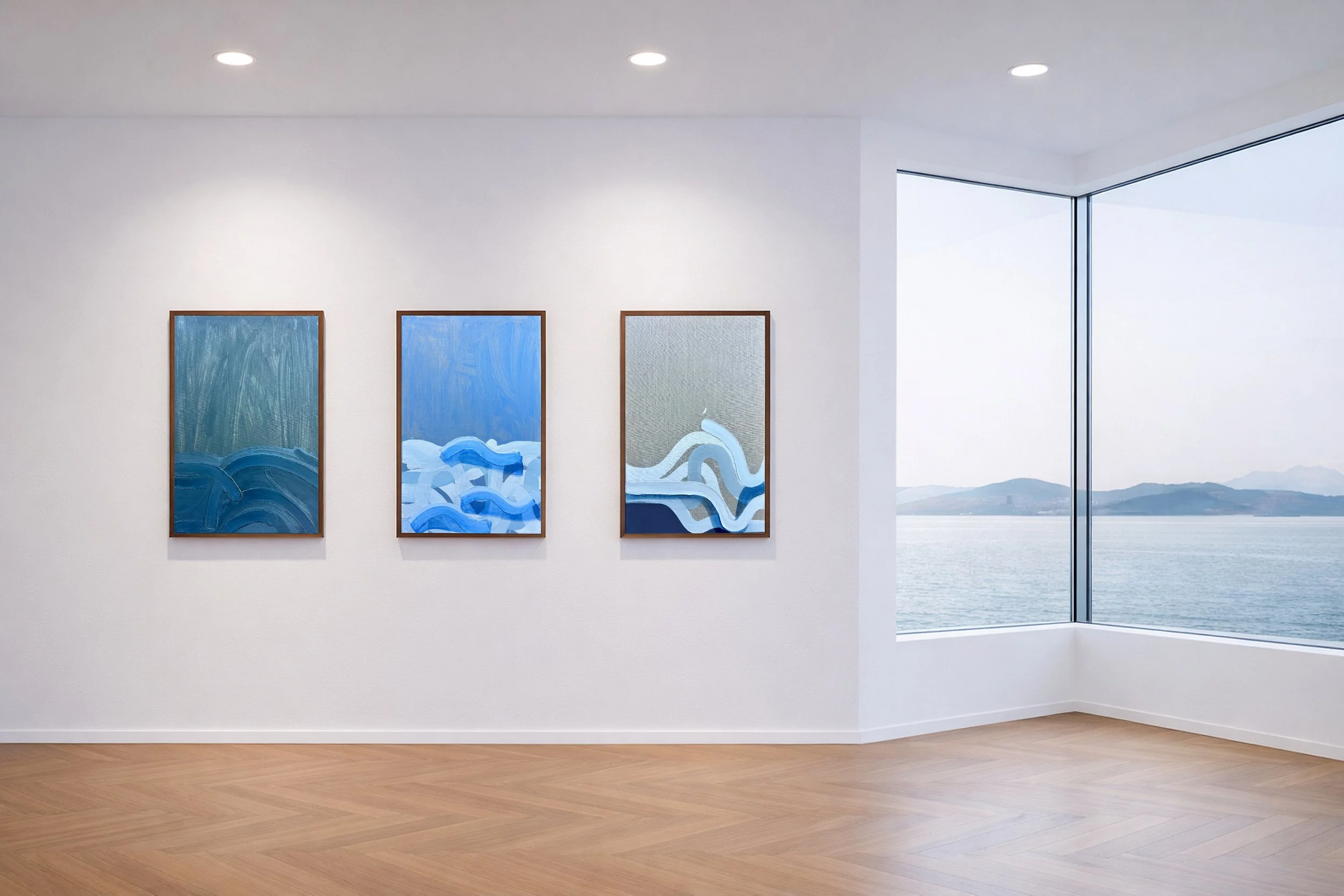
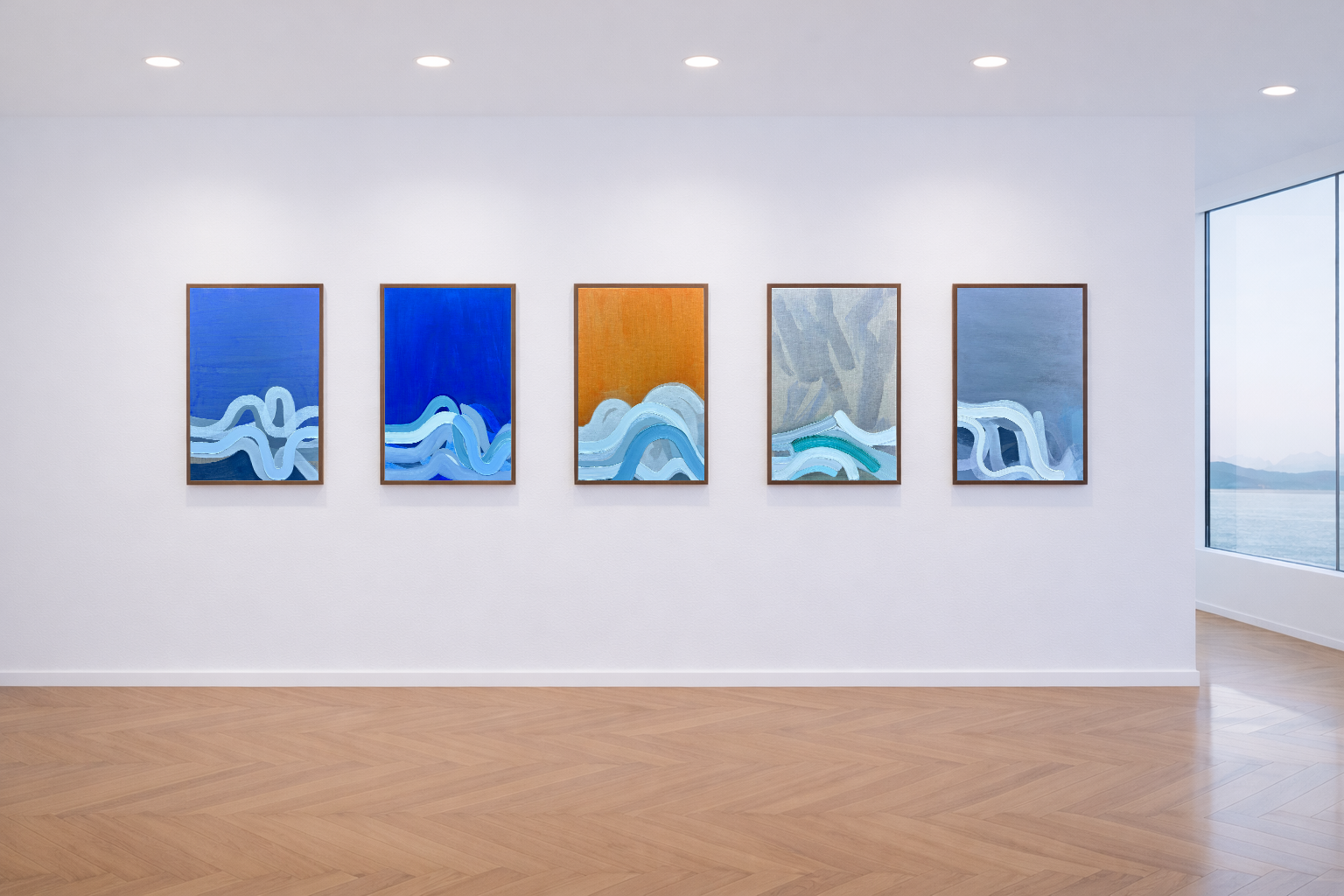
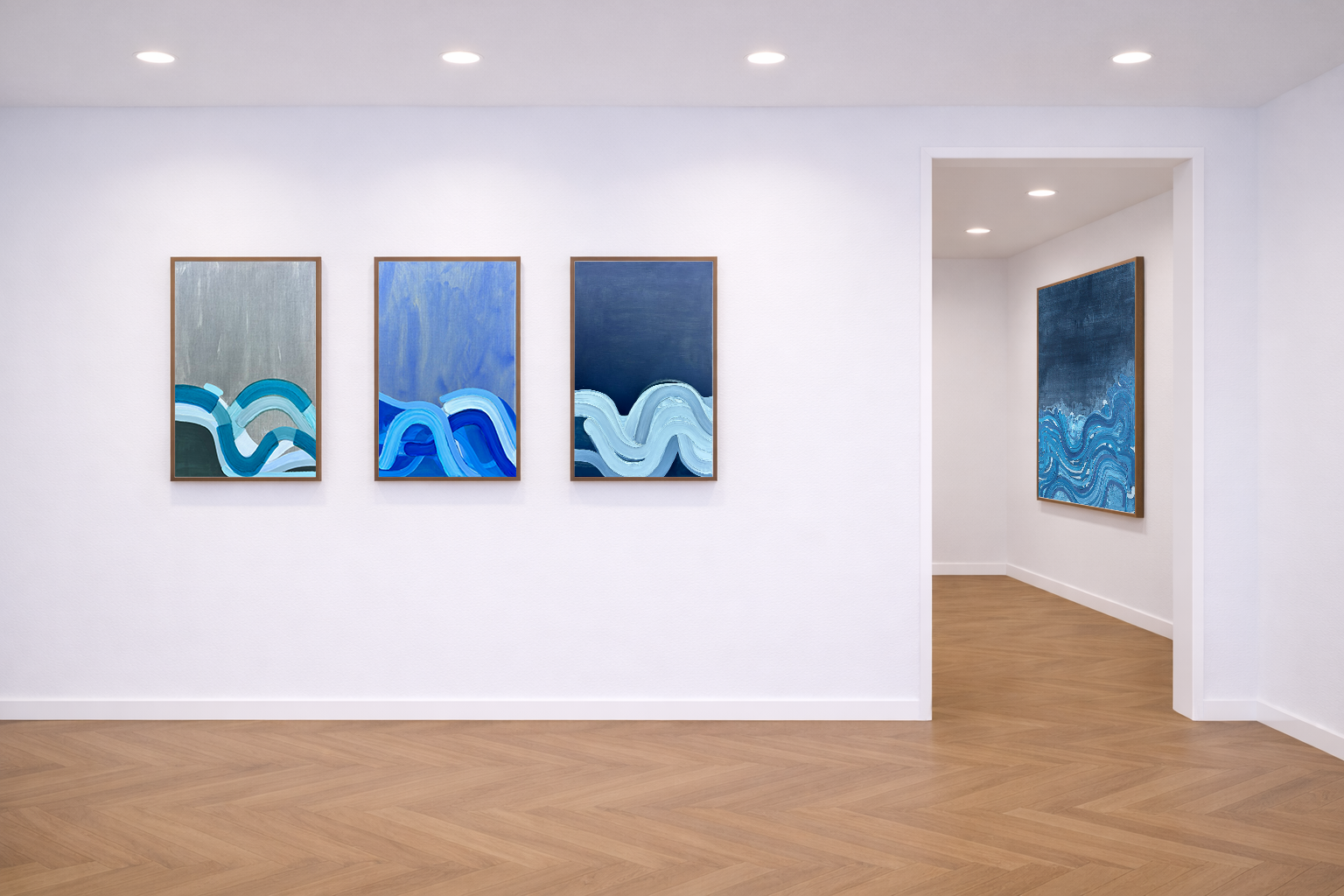
Inevitably, this body of work enters into dialogue with the art-historical tradition of the sea motif. Particularly present is the reference to Katsushika Hokusai and his iconic woodblock print The Great Wave off Kanagawa. Hokusai’s wave is compression and crescendo—a frozen instant of maximum tension, an emblem of overwhelming natural force and cyclical time at once. Millei’s waves, by contrast, refuse that moment of culmination. Where Hokusai emphasizes the dramatic event, Millei is concerned with continuity. His waves do not break; they persist. Yet both artists share an understanding of reduction: the wave becomes an archetypal form, a cipher for movement, impermanence, and return. In Millei’s contemporary reading, however, this cipher shifts from external natural power to inner experience.
A further conceptual layer opens in dialogue with Panta Rhei by the Chinese artist Liu Ren. Here, too, movement is not depicted but structurally generated. Liu Ren forms waves from language—repetitive characters that condense into flowing patterns. The Heraclitean principle of perpetual becoming—everything flows—forms a shared philosophical ground between both positions. While Liu Ren translates semantics into motion, Millei remains committed to painting. His images are sensual, material, and bodily; colour becomes feeling, gesture becomes time.
In a present defined by visual acceleration, informational density, and constant sensory overload, Millei’s works unfold a quiet resistance. They do not demand attention; they make presence possible. Their impact is not produced through spectacle, but through calm. “Feelings Are Like Water” is therefore less a series about the sea than a painterly meditation on emotional fluidity—on accepting change and indeterminacy. Water functions as a universal medium: connective, mutable, never finished. In this way, these paintings become open spaces in which individual experience can be mirrored, without being fixed in place.

