Igor Dobrowolski
Represented by G-ALLERY
Works by Igor Dobrowolski are available through G-ALLERY by private inquiry.
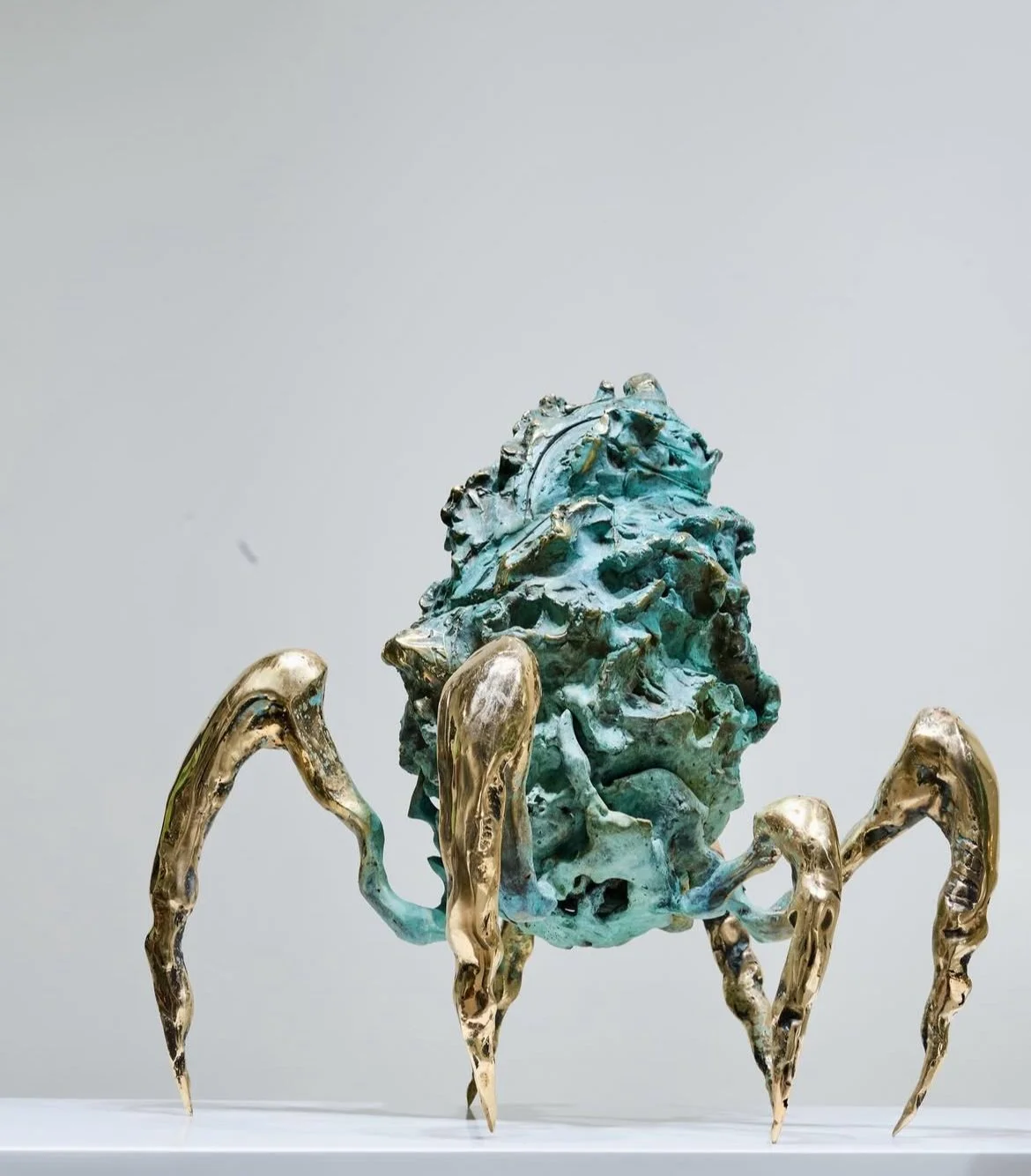
The artist Igor Dobrowolski—known for his monumental silver and metal reliefs—has recently shifted his focus toward sculpture in three-dimensional space, expanding and deepening his practice. Across media, Dobrowolski engages urgent socio-political themes such as social injustice, discrimination, forced migration, and displacement. His works often reference events that have crystallized into collective trauma—shaped by violence, humanitarian catastrophe, or war. Yet in deliberate counterpoint to these subjects stands his choice of material and the way he handles it. Scribbled marks etched into polished bronze or silver appear less menacing when caught by light; crystalline structures reflect and refract, producing moments of unexpected beauty. The visual force of his imagery is thus tempered—indeed complicated—by radiance, as the works are infused with a glimmer of hope and form an expressive, multi-layered Gesamtkunstwerk.
Dobrowolski has described his development from two-dimensional wall works toward sculpture in three-dimensional space as an intensification of what he calls his “feminine” mode of expression. As he explains, his artistic processes are shaped by distinct psychological psychological “figures”—a Child Side, Feminine Side, Tyrannical Side, and Contemporary Side—each corresponding to different formal and emotional registers in his oeuvre. In this context, sculpture becomes the realm of heightened emotion, grace, and sensitivity, whereas the reliefs—angular, sharp, and often monochrome—are connected to a more “tyrannical” side and an aesthetic of brutalism. He further notes that painting with his left hand opened a trance-like state that activated an unguarded, childlike immediacy—an experience that became foundational for his artistic self-understanding. From this point onward, he argues, he intends to pursue these psychological entities as distinct projects rather than forcing them into a single synthesis. (Igor Dobrowolski, 2023)
Dobrowolski’s works function as a catalyst for discussions that extend far beyond the artwork itself. They confront viewers with fundamental questions rooted in structural social and political failings. From early on, he developed street-art campaigns in public space, juxtaposing Western consumer culture with human suffering—always with the intention of drawing attention to social realities and using artistic expression as protest and critique. As he has stated: “I just want to give a voice to the voiceless. Because for many, the world is a merciless thing.”
In his reliefs, the artist has evolved a distinctive visual language that builds on earlier bodies of work—often realized in oil on canvas—while translating their urgency into an expanded material vocabulary. He combines metals, mirrored elements, and quartz, forming crystalline structures that possess a singular aesthetic presence. Over these surfaces, he introduces the scribbled marks already familiar from his paintings, creating a striking harmony between suffering/past and beauty/resolve. The works gain a depth that no longer centers pain alone, but is steadied—almost recalibrated—by strength and hope. Dobrowolski articulates this principle directly: “It is very important for me to include, in all of my works a particle of hope, because I believe it’s going to be ‘better.’ Even after the greatest tragedies.”
In his newest series, Feminine Side, Dobrowolski carries this principle into three-dimensional space and intensifies the viewer’s involvement. Through the fusion of organic forms with industrial materials, he recalls aspects of 1960s conceptual practices that understood art as an interplay of space, time, and form—granting the viewer a central role. Dobrowolski takes up this premise and extends it through a contemporary lens: his sculptures seek to challenge, to provoke self-questioning, and to prompt shifts in perspective. They invite viewers to reconsider their social position and the responsibilities that come with it, while simultaneously offering an aesthetic force that feels distinctive within the field of contemporary sculpture.