Mike MacKeldey
Represented by G-ALLERY
Works by Mike MacKeldey are available through G-ALLERY by private inquiry.
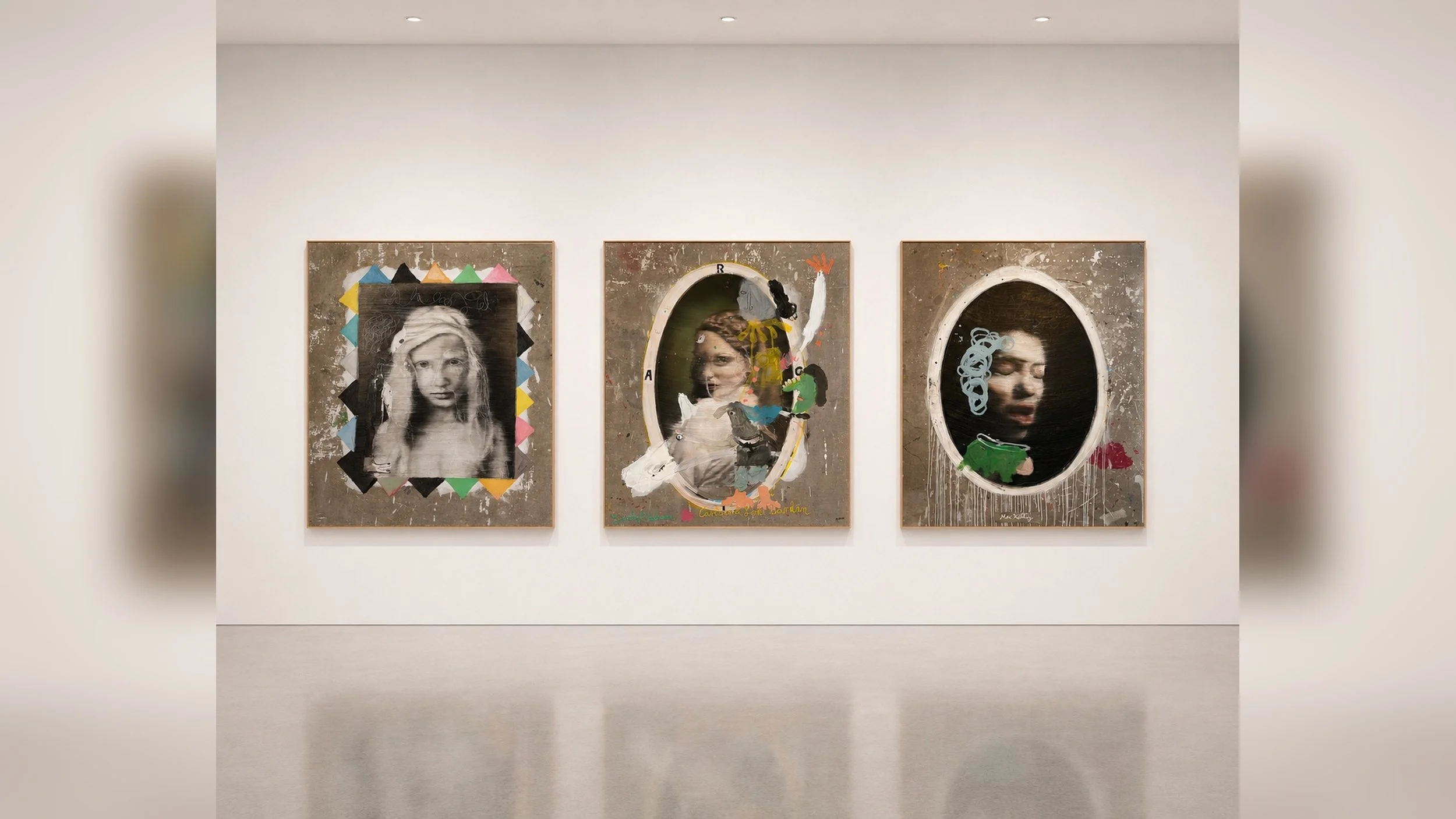
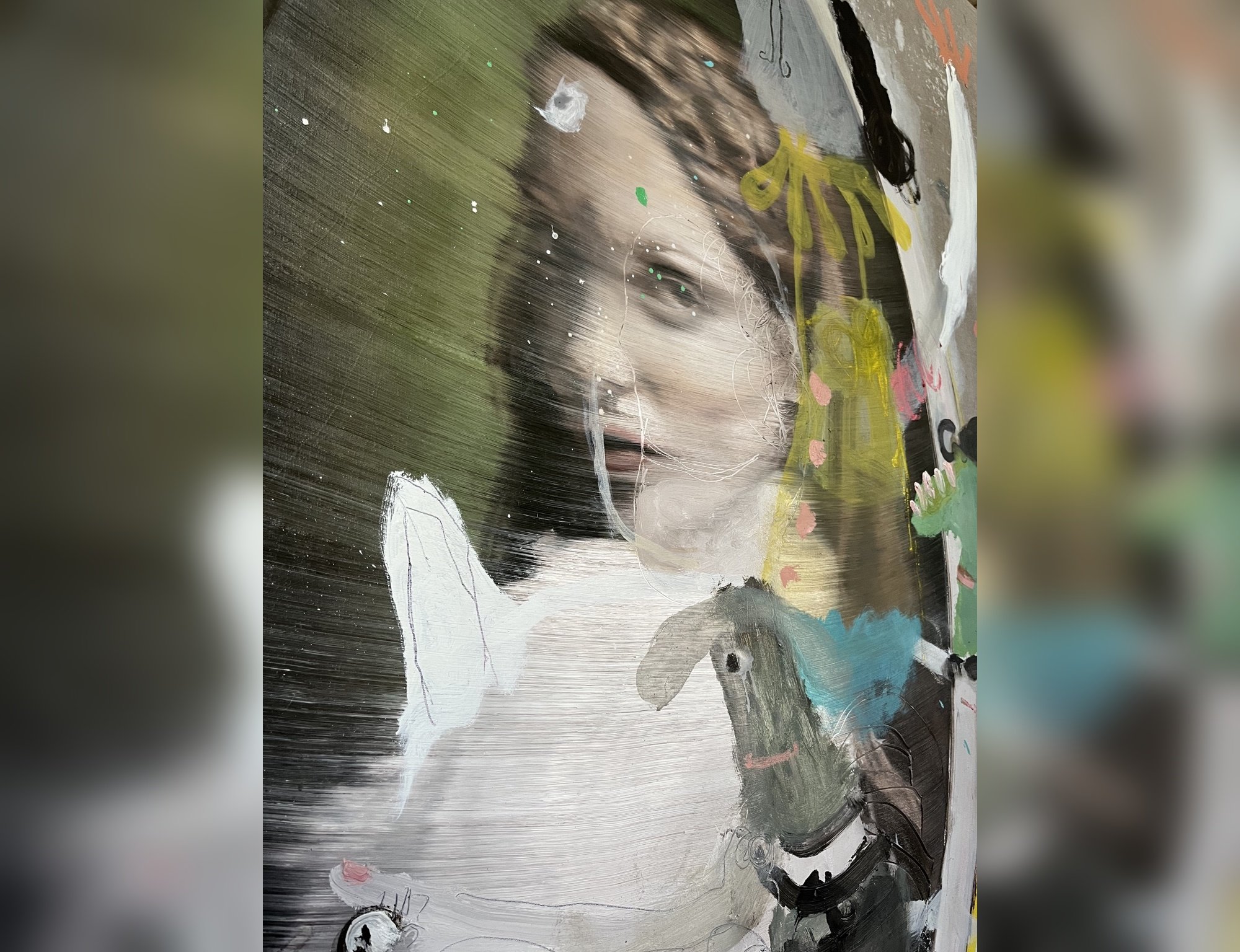
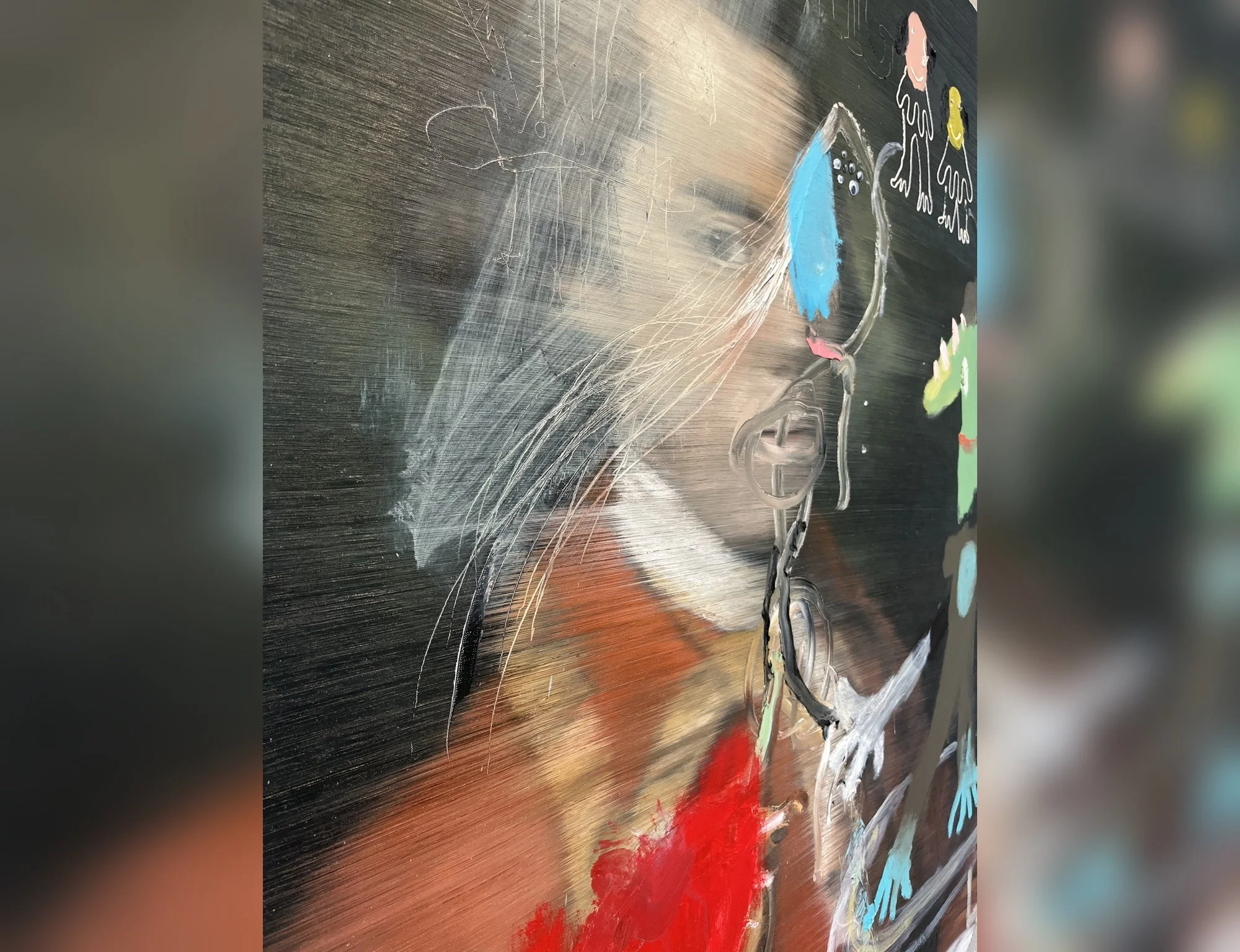
The works of the artist Mike MacKeldey, who lives in the greater Berlin area, have been presented in numerous solo exhibitions—primarily in France and Germany. His paintings recall the portraiture of the Old Masters, yet without adopting their veil of darkness. Instead, MacKeldey develops a contemporary, anti-idealizing aesthetic that expands the very notion of the portrait genre and translates it into a distinctly modern register.
MacKeldey’s works resist iconographic decoding. They do not require elaborate art-historical knowledge, nor do they insist on being approached as intellectual puzzles. Open, unforced, and seemingly unbound by fixed references, they invite sustained looking—an experience akin to entering a cabinet of curiosities, where each element suggests a discovery. Within art-historical discourse, the question of biographical interpretation is ever-present: some works appear fully accessible without context, while others unfold only once the artist’s life and experience are brought into view.
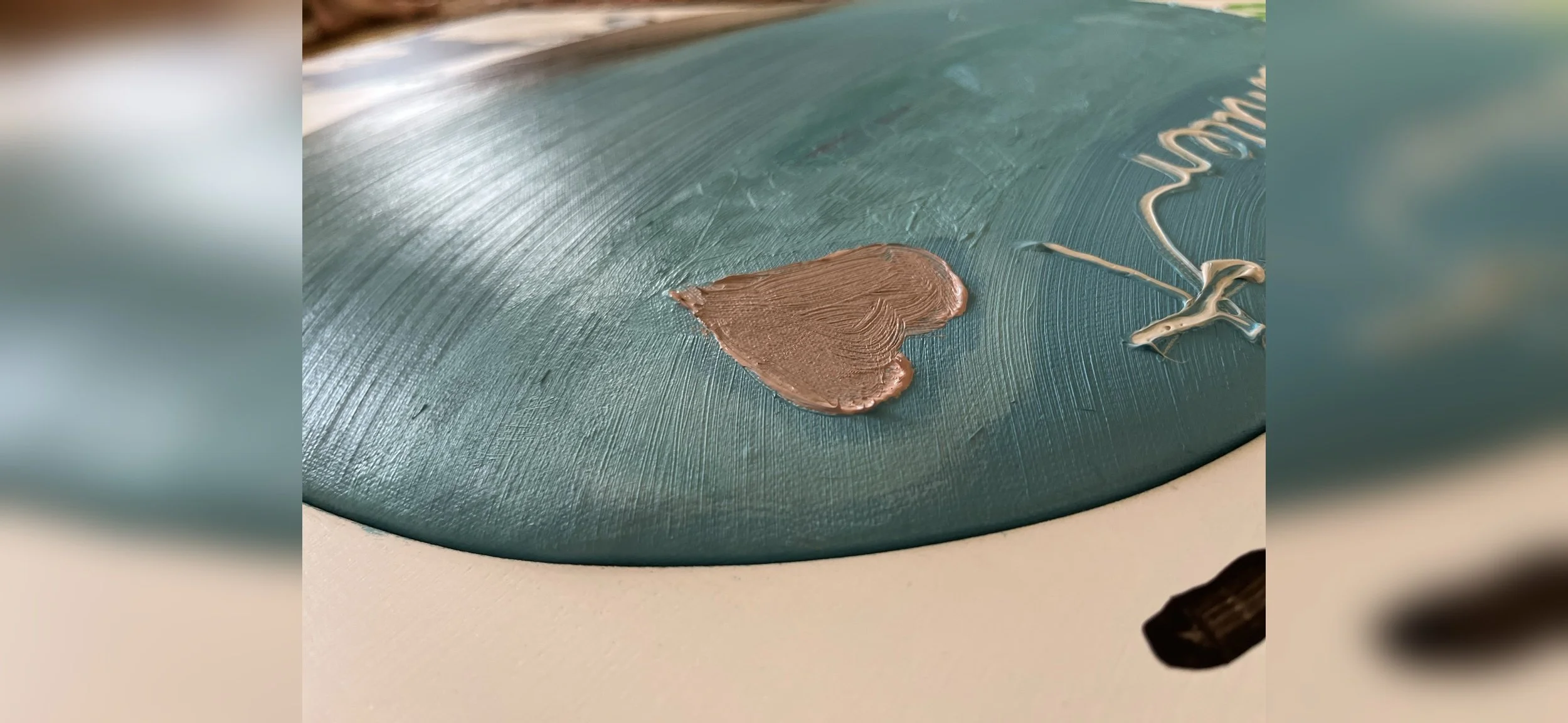
MacKeldey’s paintings move beyond biography in a conventional sense. They do not merely allude to episodes, traumas, or milestones; rather, they disclose something more intimate—deep sensibility, emotional resonance, and a particular vulnerability that permeates the image. His works contain ciphers that may appear opaque or disconnected. They register visually, yet their origin and meaning remain elusive—something to be intuited, guessed at, or left unresolved. A small anecdote reveals how such “messages” operate across his practice. Asked about the pink heart in Baron Suppe (oil on canvas/wood, 2022), the artist offers an answer emblematic of his approach: hearts have long been part of his work, though for years they were shown only to a very small circle. Often they appeared on the reverse of the canvas—hidden from the viewer and intended solely for those hanging the work. A quiet gesture that might go unnoticed, yet, when discovered, would prompt an involuntary smile.
This sense of closeness—once invisible—now moves to the front of the painting. While earlier works were often associated with a deliberate impulse toward irritation, the newer paintings feel more like an invitation: a hand extended rather than a barrier raised. They captivate without demanding reverence. Awe gives way to accessibility, accompanied by a quality of vitality and lightness. Even without biographical context, the works can be compelling; yet small autobiographical fragments illuminate why. It is here that a contemporary notion of genius emerges—one grounded in a subjective fascination that cannot be fully explained in words. The work’s auratic beauty, joined with a life-adjacent narrative, forms the basis of this renewed understanding.
At first glance, MacKeldey’s paintings evoke Baroque portraiture—historically commissioned works displayed in opulent ancestral galleries, functioning as demonstrations of power and social order. Court painters such as Peter Paul Rubens (1577–1640) produced portraits that still hold viewers in their grip, drawing them into another time. Classically, a dark ground focuses attention on the depicted figure and places it at the center of contemplation (cf. Rubens, Portrait of a Lady, oil on panel, 1625/30). There is little distraction within the image; the painter renders a real person with perfected naturalism. Yet the technical perfection becomes almost secondary, as the viewer is inevitably captured by the sitter’s commanding gaze—a gaze that also appears in MacKeldey’s work, and whose art-historical persistence remains evident to this day.
Christian Jaccard’s (*1939) work Anonyme calciné (1980) similarly dispenses with a spatial background, centering the portrait of an unknown person and directing attention toward the eyes. Even when the figure is barely legible, it is the gaze that holds us. This makes clear that the motif of looking is continuous—an instrument for producing proximity and distance alike. It establishes contact between viewer and work, yet simultaneously restricts it: historically through the demonstration of elevated social status, or, in Jaccard’s case, through scratches that recall the bars of a prison window, rendering direct encounter impossible. Jaccard draws on an iconographic narrative structure, transforms it through a modern pictorial language, and links the familiar with the new. The distancing scratches are created through deliberate burning and point toward an artistic expression situated between naturalism and an expressionist abstraction.


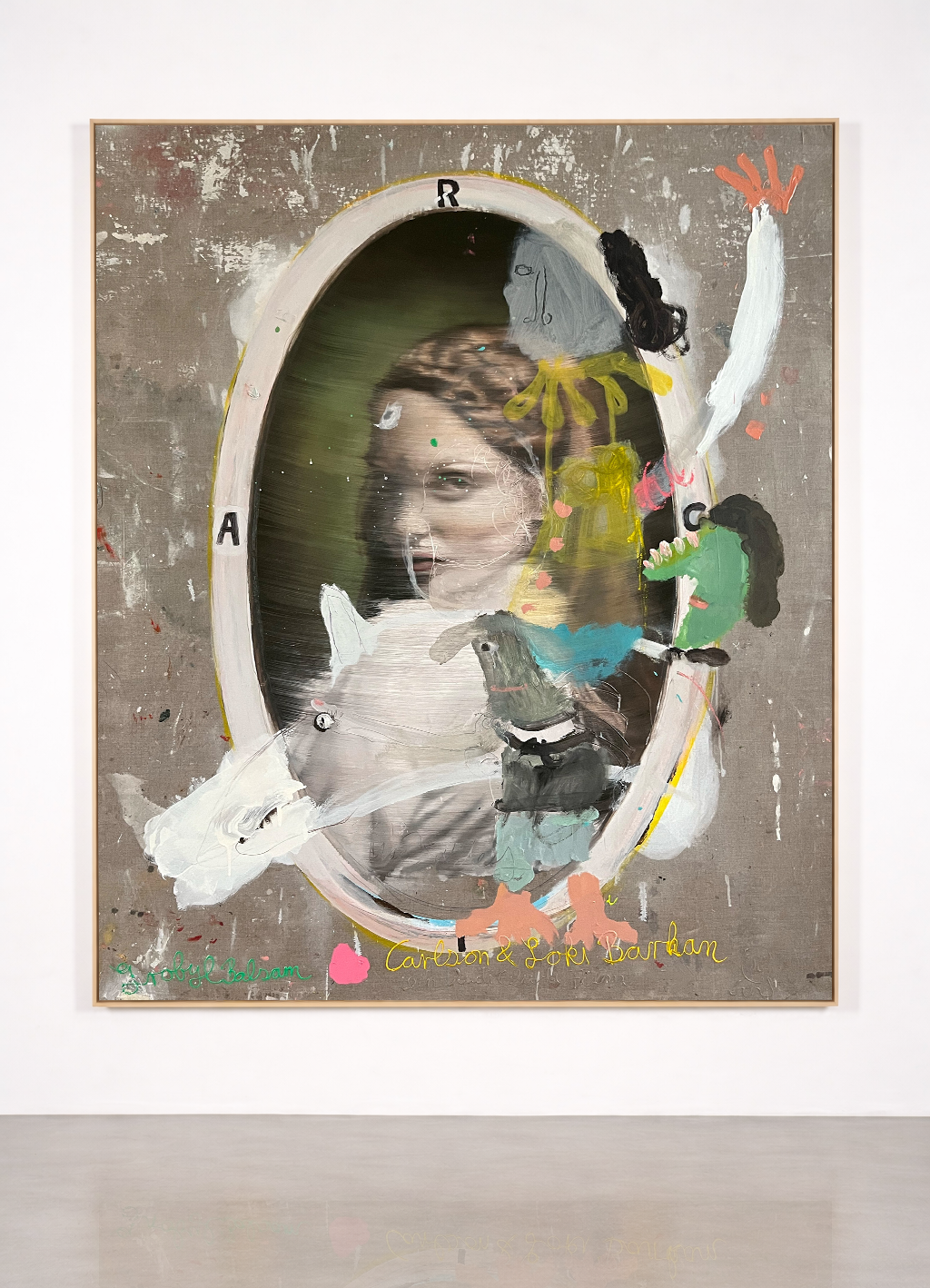
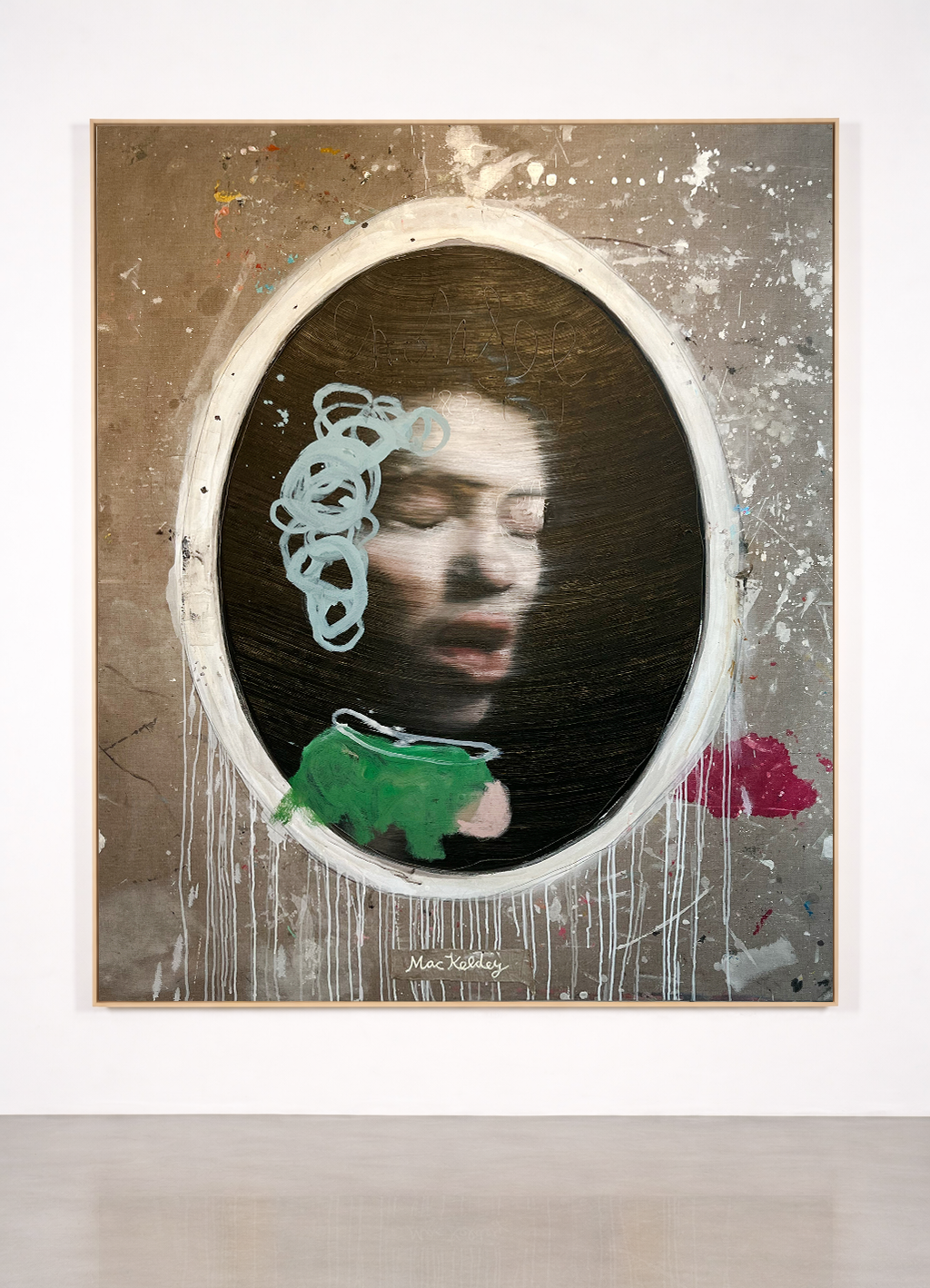
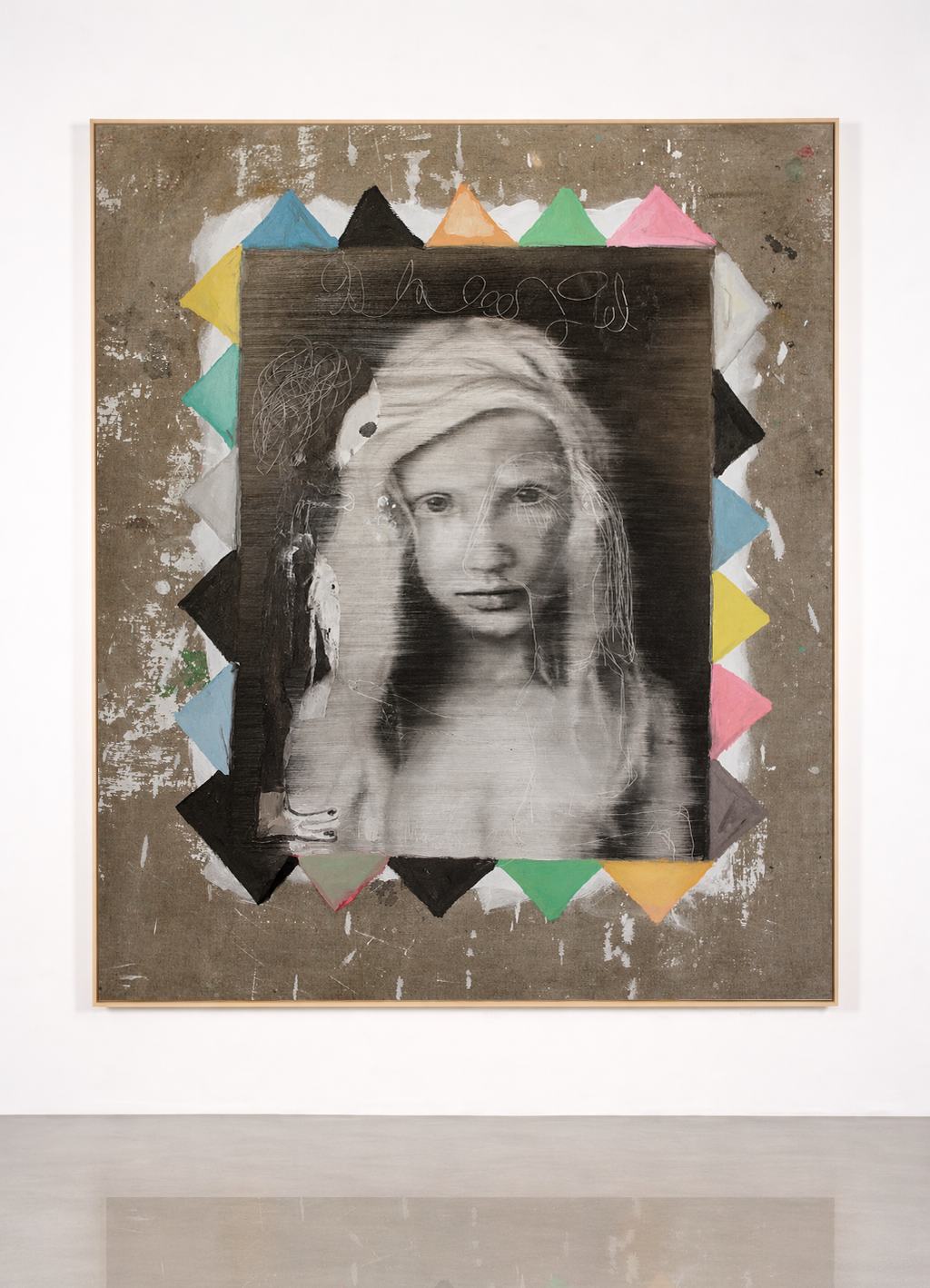
A mode of expression that can also be found in Mike MacKeldey’s work. Like Jaccard, he dispenses with a descriptive, representational background and instead offers a space for imagination. His portraits do not fill the entire canvas; they occupy the center of the painting while leaving room for other pictorial motifs—thereby deforming the construct of power traditionally inherent to Baroque portraiture. He allows the raw canvas to show through, creating a “picture-within-a-picture” effect that is further intensified by colorful scribbles and abstract figures that seem to clamber across the surface. These marks inevitably recall the work of the American painter Cy Twombly (1928–2011). Twombly rejected concrete depiction and, abandoning oil or acrylic as primary vehicles, focused instead on pencil and the bare canvas. What may initially appear chaotic or disconnected reveals, with longer viewing, a distinct dynamism—a rhythm, even a new form of narrative structure.
In Twombly’s Leda and the Swan (1962), three key elements become legible upon closer inspection. Near the bottom, the title can be discerned; from the center toward the upper right, hearts appear; and along the upper edge, a lone window stands isolated, without further pictorial elements. Suddenly, the work’s anchoring in the myth of Leda and the Swan becomes apparent: Zeus transforms himself into a swan in order to seduce Leda and impregnates her. The hearts provide visual cues to this narrative, while the seemingly aggressive, erratic strokes and scratches convey its rhythm and surging momentum. It is as if the painter’s sensations find their direct expression through the pencil on the canvas.
It is precisely this depth of inner, unrestrained articulation that MacKeldey’s paintings continue. He, too, leaves messages embedded in his works—signals that must be approached rather than decoded. Sometimes these are single words recurring across paintings; sometimes they appear as full sentences that read as ironic, yet remain only partially comprehensible. At other moments, they are sequences of letters whose semantic relation refuses to settle—phrases that seem to have sprung directly from the painter’s imagination. When a word appears to be recognizable—“Loki,” for instance (cf. Boawrj, oil on canvas, 2022)—viewers may instinctively place it within a familiar cultural frame, perhaps Norse mythology, only to find that such interpretive certainty contributes little to an authentic encounter with the painting. And indeed it does not—because a visit to the artist’s studio reveals a sweet, fluffy cat who answers to the name “Loki.” A small word—four letters—quietly confronts the viewer’s intellectual ambition and, with disarming charm, gently makes fun of it.
Equally amusing is the fact that the scribbled word “Laphroaig” (cf. Laphs Kongi Brause Klause, oil on canvas, 2022) is not to be attributed to any historical figure at all; rather, Laphroaig is a Scottish whisky. Knowing that whisky is the artist’s preferred drink, the discreet word-number combination “70cl,” found along the lower edge, becomes entirely coherent. Alongside these scribbles, MacKeldey’s recent paintings repeatedly introduce a figure resembling a fantastical creature. With a green face, squid-like feet, and an arm gesture turned toward the viewer—one that recalls Aby Warburg’s (1866–1929) concept of the Pathosformel—it emerges at the front of the canvas. The figure occupies a special position within the work, as it is stylistically and chromatically distinct from the portrait and appears to welcome the viewer with an open, warm gesture. MacKeldey strengthens the impression of its significance by consistently placing it on a pedestal—an element that makes the creature appear elevated in relation to the other figures in the painting. The pedestal, traditionally an instrument for disseminating messages and reaching an audience, underscores its role: this bright being guides viewers through the artist’s universe, as if introducing it.
The association with an octopus, triggered by the creature’s feet, recurs—transformed—in other figures as well. It appears as though smaller figures positioned near this fantastical being wear a kind of collar: an “octopus collar,” unfamiliar and strange, yet faintly reminiscent of a theatrical ruff or a Victorian “father-killer” collar. Such collars evoke formal occasions and create a temporal link to the portrait that shimmers through in the background. Looking at the paintings from 2022, the “octopus” seems omnipresent across different levels: as a word, a motif, a symbol—one that cannot be anticipated through logical narrative sequences. The viewer cannot fully follow MacKeldey’s thoughts and instead encounters an artistic mind that remains fascinating precisely because it cannot be made fully transparent. Remarkably, the works leave viewers with questions and open associations without provoking the need for resolution. It is as if the artistic freedom experienced in these paintings finds resonance within the viewer’s own sensory world.
MacKeldey’s works blur the boundaries between the real and the fictive: the naturalistic rendering of the portrait, the abstract fantasy beings, and the cipher-like signs that tap into a collective memory merge into a singular, unmistakable pictorial language. They captivate through their uniqueness, recall the technical mastery of great painters, and activate imagination with striking immediacy—leaving behind a sense of liberation, a lightness akin to something childlike.
Mike MacKeldey — Biography and Selected CV
Bio
Mike MacKeldey is a German contemporary artist born in Frankfurt am Main in 1973. His work moves between painting, figuration, and conceptual image-making, engaging visual memory, cultural codes, and the constructed nature of representation.
Awards
- 2015Art award of the collection Merkel + Foundation
- 2014Promotion award of the collection Merkel + Foundation
- 2002Art award 1822, Frankfurt am Main
- 1998Award of Creativity, Darmstadt
Biennale
- 2016Ansbach Contemporary
Selected Museum Exhibitions
- 2026Lentos Museum Linz, Mädchen* sein!? Vom Tafelbild zu Social Media, Austria
- 2019Can Mario Museum, Palafrugell (Girona), Spain
- 2018Torrance Art Museum, Torrance, USA
- 2017Musée des Beaux-Arts, Saint-Lô, France
- 2016Kunstverein Pforzheim, Pforzheim, Germany
- 2015Musée Cognac-Jay, Paris, France
- 2012Museum Dhondt-Dhaenens, Deurle, Belgium
- 2011Kunstsammlung Nordrhein-Westfalen, K20, Düsseldorf, Germany
Solo Exhibitions (selection)
- 2025GALERIE SUPPER, Baden-Baden
- 2024Villa Lies, Berlin
- 2022Galerie Klose, Essen
- 2022G-ALLERY, Berlin
- 2021Galerie Da End, Paris, France
- 2021Galerie Palmer, Stuttgart (artist group Mike MacKeldey & Ellen DeElaine)
- 2020Galerie Palmer, Stuttgart
- 2020GALERIE SUPPER, Baden-Baden (with Andreas Wachter)
- 2018GALERIE SUPPER, Baden-Baden
- 2018Galerie Klose, Essen
- 2017Villa de Bank, Enschede, Netherlands (artist group Mike MacKeldey & Ellen DeElaine)
- 2017Galerie Da End, Paris, France
- 2016Kunstverein Pforzheim (artist group Mike MacKeldey & Ellen DeElaine)
- 2015Galerie Da End, Paris, France
- 2015GALERIE SUPPER, Baden-Baden
- 2015Galerie Klose, Essen
- 2013Evelyn Drewes Galerie, Hamburg
- 2011Stephane Simoens Contemporary Fine Art, Knokke-Zoute, Belgium
- 2011GALERIE SUPPER, Karlsruhe
- 2011Galerie apollo9, Hamburg
- 2010Galerie Klose, Essen
- 2010Galerie Son, Berlin
- 2010Heyne Kunstfabrik, Offenbach
- 2008Galerie Studio 01, Wiesbaden
- 2006Galerie Wildwechsel, Frankfurt am Main
- 2005Max Wigram Gallery, London, England
- 2003Projektraum 5. Element, Frankfurt am Main
- 1999Galerie Ars Vivendi, Kronberg
Group Exhibitions (selection)
- 2025Lentos Kunstmuseum Linz, Austria
- 2024Art Lüdersdorf
- 2024GALERIE SUPPER, Baden-Baden
- 2024Hilbertraum, Berlin
- 2023Galerie Da End, Paris, France
- 2023Palmer, Galeriehaus 3.0, Stuttgart
- 2022Galerie Da End, Paris, France
- 2022GALERIE SUPPER, Baden-Baden
- 2021Stadtgalerie Bad Soden
- 2020Galerie Reinart, Schaffhausen, Switzerland
- 2020Galerie Da End, Paris, France
- 2020art gallery, Paju City, South Korea
- 2020GALERIE SUPPER, Baden-Baden
- 2019Can Mario Museum, Palafrugell (Girona), Spain
- 2019Galerie Da End, Paris, France
- 2019Stadtgalerie Bad Soden
- 2019GALERIE SUPPER, Baden-Baden
- 2019Galerie Anette Müller, Düsseldorf
- 2019Galerie Klose, Essen
- 2018Torrance Art Museum, Torrance, USA
- 2018clair-obscur, Berlin
- 2018Galerie Da End, Paris, France
- 2018GALERIE SUPPER, Baden-Baden
- 2017Musée des Beaux-Arts, Saint-Lô, France
- 2017Galerie Da End, Paris, France
- 2017KunstRaum Bernusstraße, Frankfurt am Main
- 2017Hilbertraum, Berlin
- 2017GALERIE SUPPER, Baden-Baden
- 2016Galerie Da End, Paris, France
- 2016BUSCHE Berlin
- 2016Kunstraum Riedberg, Frankfurt am Main
- 2016GALERIE SUPPER, Baden-Baden
- 2015Musée Cognac-Jay, Paris, France
- 2015Hilbertraum, Berlin
- 2015Kunstraum Neureuth e.V., Karlsruhe
- 2015Ausstellungshalle Schulstraße, Frankfurt am Main
- 2015Galerie Polaris, Paris, France
- 2015Galerie Da End, Paris, France
- 2015GALERIE SUPPER, Baden-Baden
- 2015Galerie Klose, Essen
- 2014Galerie Da End, Paris, France
- 2014Galerie Evelyn Drewes, Hamburg (with Markus Lüpertz and Arnulf Rainer)
- 2014Galerie Anette Müller, Düsseldorf
- 2014Galerie Evelyn Drewes, Berlin
- 2014Kaiser + Cream, Wiesbaden
- 2013Stephane Simoens Contemporary Fine Art, Knokke, Belgium
- 2013GALERIE SUPPER, Baden-Baden (with Markus Lüpertz and Arnulf Rainer)
- 2013Galerie Klose, Essen (with Markus Lüpertz and Arnulf Rainer)
- 2013Heyne Kunstfabrik, Offenbach
- 2012Museum Dhondt-Dhaenens, Deurle, Belgium
- 2012Blackall Studios, London, England (artist group Mike MacKeldey & Ellen DeElaine)
- 2012salondergegenwart, Elbhof, Hamburg (artist group Mike MacKeldey & Ellen DeElaine)
- 2012GALERIE SUPPER, Karlsruhe
- 2012Galerie Klose, Essen
- 2011Kunstsammlung Nordrhein-Westfalen, K20, Düsseldorf
- 2011gallery space↓, Jeonbuk, South Korea
- 2011O's Gallery, Jeonbuk, South Korea
- 2011Villa de Bank, Enschede, Netherlands
- 2011Price Waterhouse Coopers, Düsseldorf
- 2011Kunstraum Bernusstraße, Frankfurt am Main
- 2011Balken, Frankfurt am Main
- 2011Galerie Gegenwart, Karlsruhe
- 2011Galerie Klose, Essen
- 201112. Kunstansichten, Offenbach