Kyle A. Dunn
Represented by G-ALLERY
Works by Kyle A. Dunn are available through G-ALLERY by private inquiry.
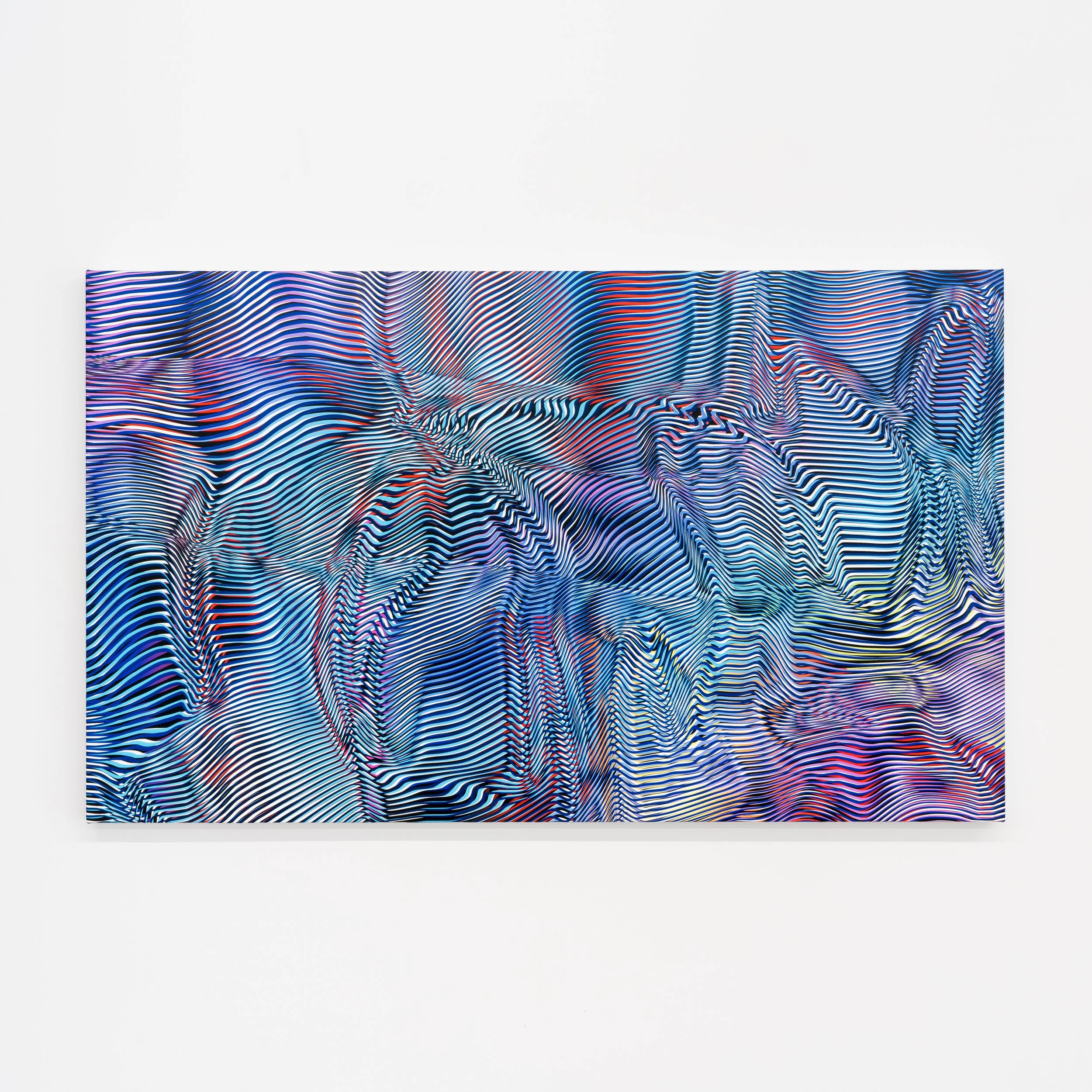
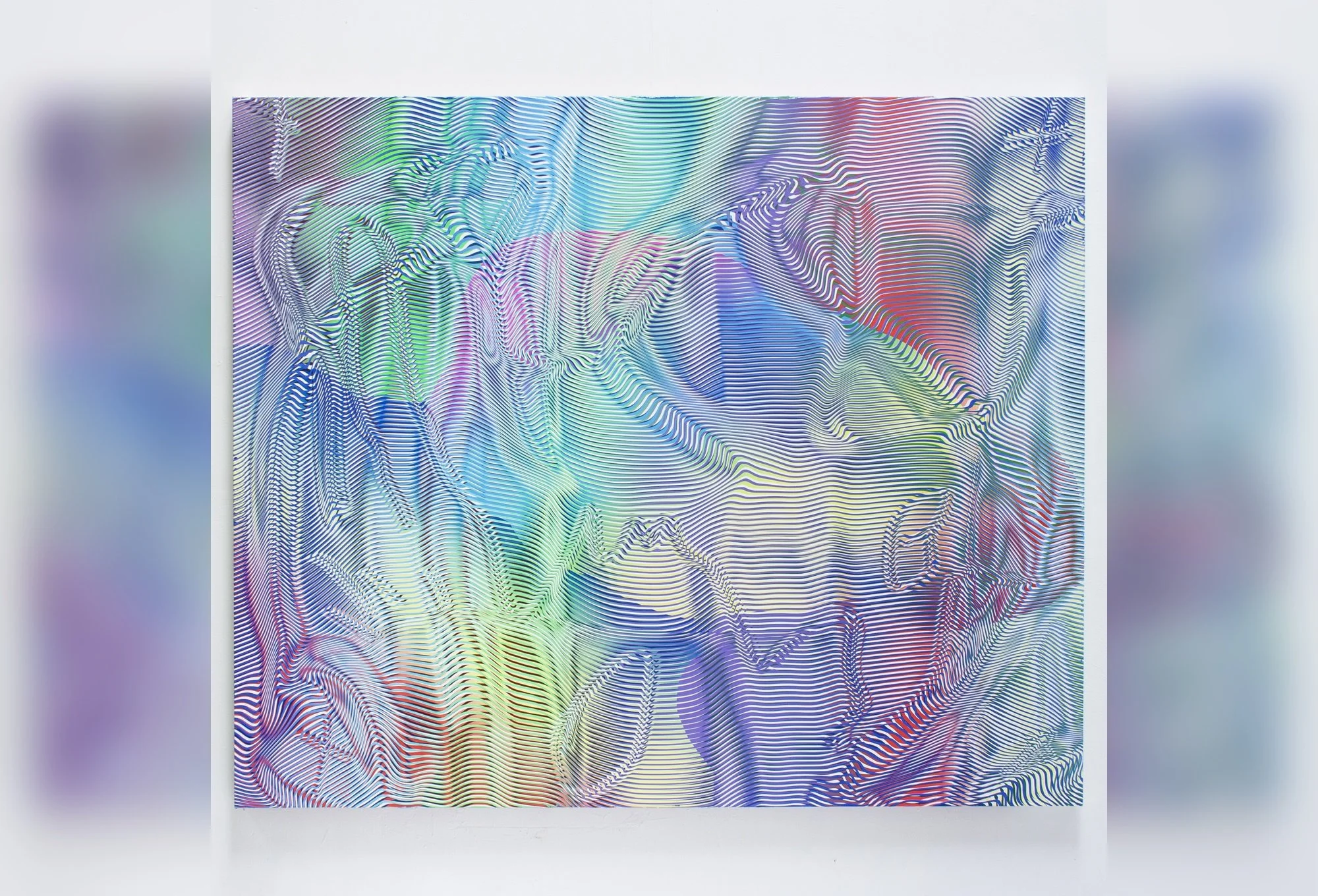
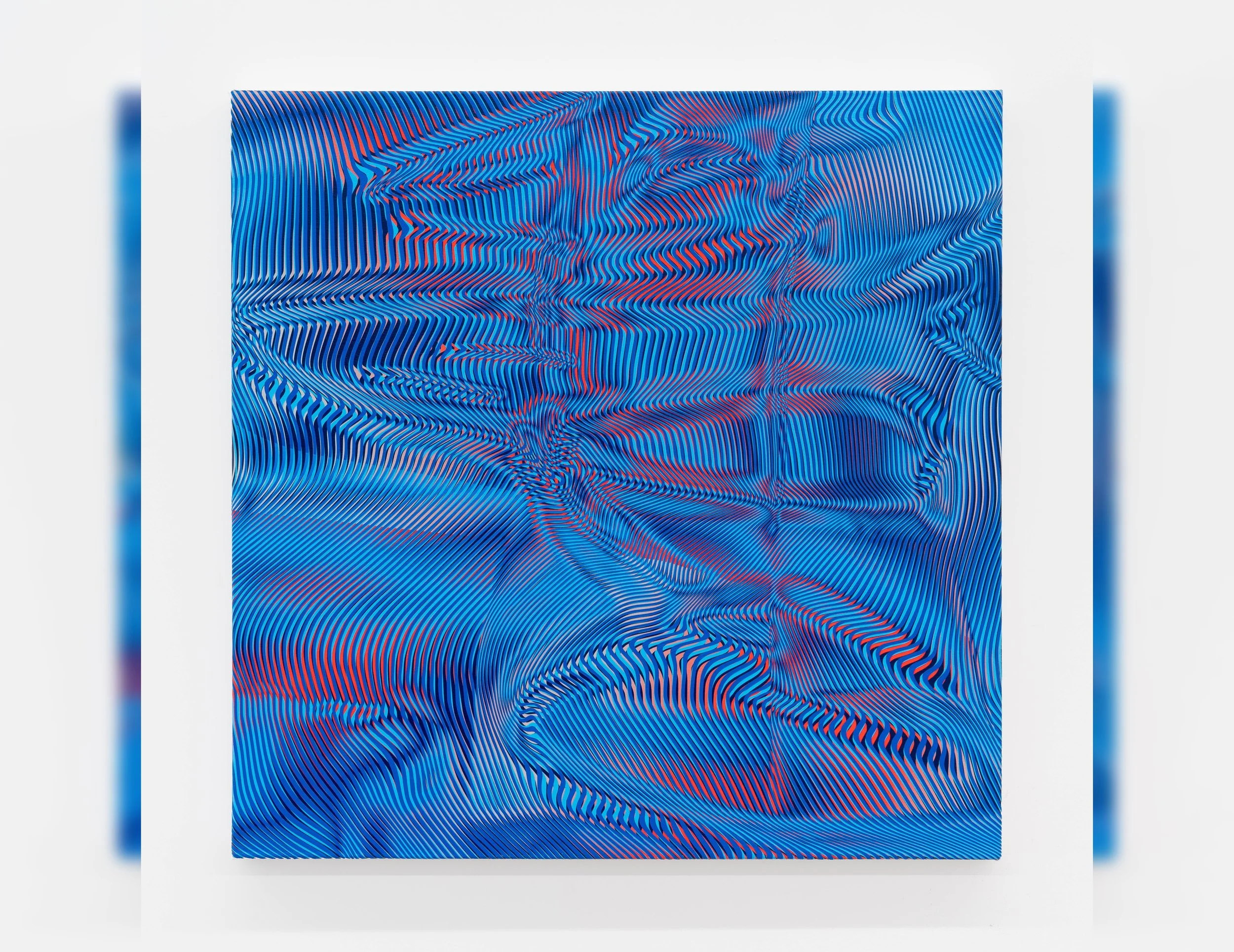
Kyle A. Dunn (*1987, Oakland, USA) is an ultra-contemporary artist whose practice is closely aligned with the discourse of “The New Abstraction” in contemporary art. His paintings are distinguished by a highly controlled visual language that merges geometric abstraction, optical illusion, and perceptual experimentation. Through the deliberate orchestration of contrasting colors, linear structures, and rhythmic repetition, Dunn constructs compositions that activate the picture plane with a striking optical intensity. His works generate a dynamic interplay between order and disruption, producing visual effects that oscillate between stability and movement, precision and disorientation.
Central to Dunn’s practice is a sustained investigation into the mechanics of visual perception. His paintings engage directly with the viewer’s cognitive processes, challenging how the eye interprets pattern, depth, and spatial relationships. Repetitive structures and carefully calibrated line systems create subtle distortions and vibrations that seem to shift as one moves before the work. This creates an immersive viewing experience in which the painting is not static, but continuously unfolding—an effect that situates Dunn’s work within a lineage of optical abstraction while simultaneously extending it into a distinctly contemporary context.
In his recent work Internal Dialogue, presented publicly for the first time, Dunn intensifies this exploration through a reduced palette of black and white. By stripping away chromatic complexity, the composition sharpens its focus on structure, contrast, and visual tension. The result is a work that appears at once minimal and highly charged: a precise arrangement of lines and forms that produces a pulsating field of visual energy. The painting seems to hover between clarity and fragmentation, inviting the viewer into a state of perceptual uncertainty that is both analytical and visceral.
Dunn’s work operates at the intersection of contemporary abstract painting and perceptual theory. His compositions prompt a reconsideration of how visual information is constructed and processed, positioning the act of looking as an active, interpretive experience. Rather than presenting a fixed image, his paintings function as systems—responsive fields that shift depending on the viewer’s position, focus, and duration of engagement. In this sense, Dunn expands the possibilities of contemporary painting, moving beyond representation toward a more experiential and phenomenological understanding of the image.
“The New Abstraction,” with which Dunn is frequently associated, represents a significant current within contemporary art that reconsiders the role of abstraction in a digital and image-saturated age. Artists working within this framework move beyond traditional non-representational strategies, integrating elements of technology, visual culture, and conceptual inquiry. The movement encompasses a wide spectrum of approaches, from materially driven painting practices to digitally informed aesthetics, unified by a shared interest in redefining the language of abstraction for the present moment.
A defining characteristic of this field is the heightened emphasis on surface, structure, and visual impact. Color, texture, and compositional rhythm are not merely formal concerns, but become vehicles for exploring perception, cognition, and the conditions of contemporary visual experience. Artists such as Dunn employ systematic processes—layering, repetition, and modulation—to produce works that are both formally rigorous and sensorially engaging. These paintings often operate at the threshold between control and instability, inviting viewers to navigate shifting visual environments that resist immediate resolution.
Equally central to “The New Abstraction” is the evolving relationship between artwork and viewer. In an era shaped by digital interfaces and accelerated image consumption, contemporary abstract artists increasingly create works that demand sustained attention and active participation. Dunn’s paintings exemplify this condition: they slow down perception, encouraging viewers to look longer, to question what they see, and to become aware of their own role in constructing visual meaning.
Within this context, Kyle A. Dunn’s work occupies a distinct and compelling position. His paintings combine formal precision with perceptual complexity, offering a sophisticated engagement with contemporary abstraction, optical art, and the psychology of vision. As both visually striking objects and conceptual investigations, his works resonate with collectors and institutions interested in cutting-edge contemporary painting, perceptual abstraction, and the evolving discourse of “The New Abstraction.”
Kyle A. Dunn — Biography and Selected CV
Bio
Kyle A. Dunn is an American contemporary artist whose practice explores color, perception, and abstraction through painting. His work engages visual rhythm, spatial tension, and optical interplay, developing a distinct painterly language that moves between structure and instability.
Education: MFA, Studio Art, University of California, Davis; BFA, Drawing, University of Florida, Florida.
Selected Solo / Two-Person Exhibitions
- 2024Motto, Galleria Nicola Pedana, Caserta, Italy
- 2024Ruled By Possibility, Galerie Robertson Arès, Montreal, QC, Canada
- 2020Directions With No Endpoints, Galerie Robertson Arès, Montreal, QC, Canada
- 2020Captive Reflex, Double Strength at Gallery 16, San Francisco, CA
- 2019BUZZ, First Amendment Gallery, San Francisco, CA
- 2018Illusion of Control, Jackknife Gallery, Oakland, CA (with Paul Taylor)
- 2014Back and Forth: Collaborative Paintings, Hap Gallery, Portland, OR (with Mathew Zefeldt)
Selected Group Exhibitions
- 2025Artefiera, with Galleria Nicola Pedana, Bologna, Italy
- 2025The New Abstraction, G-ALLERY, Paris, France
- 2024Sweaty Armpits, 1201710 Gallery, Berkeley, CA
- 2024Miradas, Cohle Gallery, Menorca, Spain
- 2024Chroma, Galerie Robertson Arès, Montreal, QC, Canada
- 2024Artefiera, with Galleria Nicola Pedana, Bologna, Italy
- 2023T.R.A.C.E., Transient Labs and MakersPlace, Sagamore Hotel, Miami, FL
- 2023Winter Show, Galleri Christoffer Egelund, Copenhagen, Denmark
- 2023Moments, Soft Times Gallery, San Francisco, CA
- 2023ArtVerona, with Galleria Nicola Pedana, Verona, Italy
- 2023Art Toronto, with Galerie Robertson Arès, Toronto, ON, Canada
- 2023Small Works 2, Soft Times Gallery, San Francisco, CA
- 2023Miart, with Galleria Nicola Pedana, Milan, Italy
- 2022Interlocking Colors, Galleria Nicola Pedana, Caserta, Italy
- 2022Ultra Contemporary 22, G-ALLERY, Berlin, Germany
- 2022Hard Edge, Galerie Robertson Arès, Montreal, QC, Canada
- 2022Rare Candy, Soft Times Gallery, San Francisco, CA
- 2022Laboratory of Forms, Agrella Gallery at Santa Rosa Junior College, Santa Rosa, CA
- 2022INAUGURAL, Soft Times Gallery, San Francisco, CA
- 2022Papier 2022, with Galerie Robertson Arès, Montreal, QC, Canada
- 2020Art Toronto, with Galerie Robertson Arès, Montreal, QC, Canada
- 2019New Era, Galerie Robertson Arès, Montreal, QC, Canada
- 2019Spraybow, Flowers Art Gallery, Oakland, CA
- 2018Trinary, Gregory Kondos Gallery, Sacramento City College, Sacramento, CA
- 2017Axis Picks, Axis Gallery, Sacramento, CA
- 2014Omnis International, Minan Gallery, Los Angeles, CA
- 2013Present Tense, Headlands Center for the Arts, Sausalito, CA
- 2012What we can’t see but want to see is art, Pro Arts Gallery, Oakland, CA
- 2012Lightning Strikes Twice, Circuit 12 Contemporary Gallery, Dallas, TX
Selected Publications
- 2022BOOOOOOOM, “Artist Spotlight: Kyle Austin Dunn”
- 2019New American Paintings, Pacific Coast Issue #145, juror Christine Y. Kim
Residencies and Awards
- 2022Associate Artist Residency (with Mentor Artist Ryan McGinness), Atlantic Center for the Arts, New Smyrna Beach, FL
- 2013Affiliate Artist Residency, Headlands Center for the Arts, Sausalito, CA
- 2012Graduate Fellowship Residency, Headlands Center for the Arts, Sausalito, CA
- 2012Faye Nelson MFA Award, Art Department, University of California, Davis, CA
- 2011Mary Lou Osborn MFA Award, Art Department, University of California, Davis, CA