John Millei
Feelings Are Like Water
oil on canvas
91 × 64 cm / 35.8 × 25.2 in (height × width)
91 × 64 cm / 35.8 × 25.2 in
An individual painting / John Millei
John MilleiFeelings Are Like Water
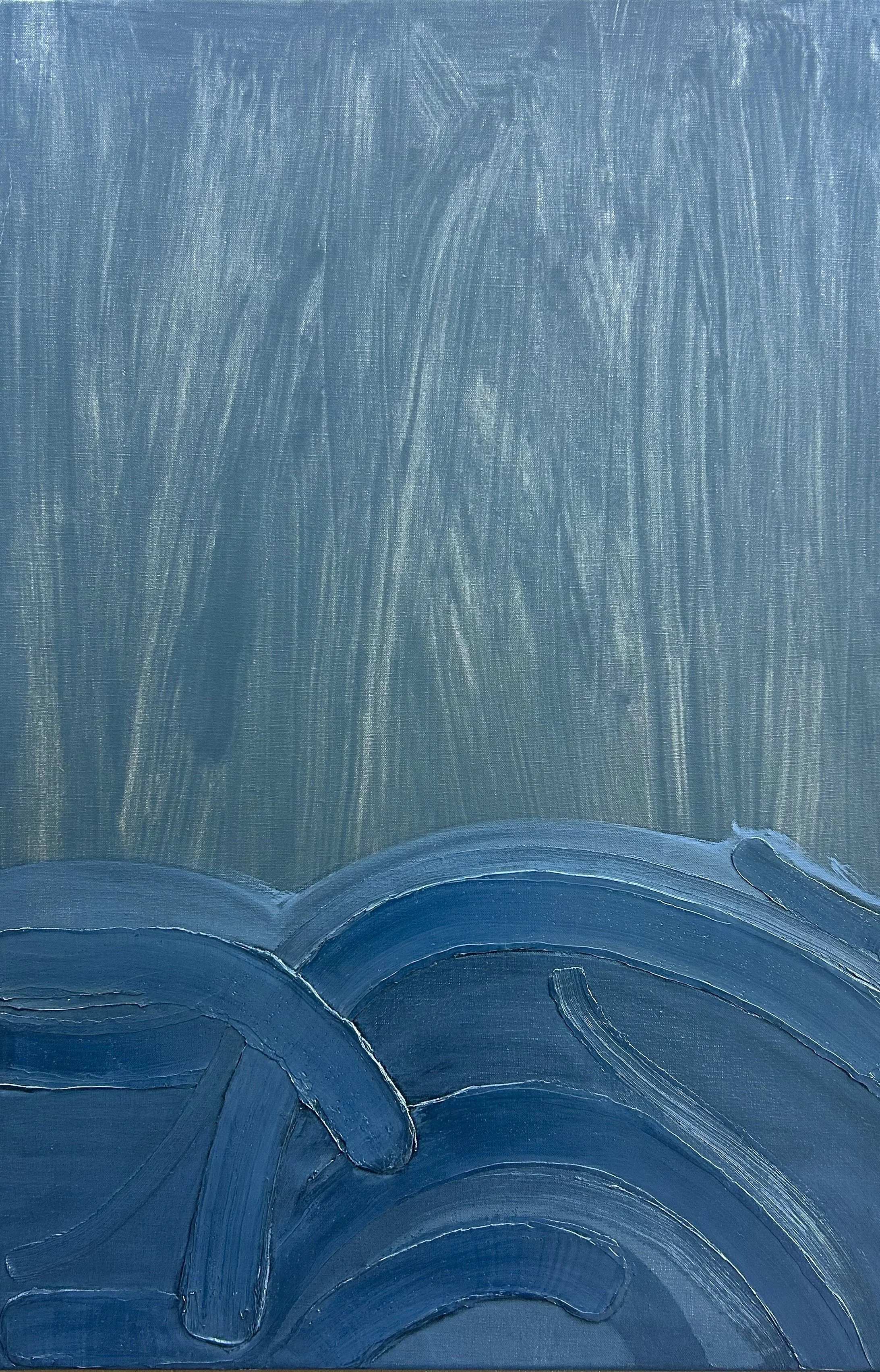
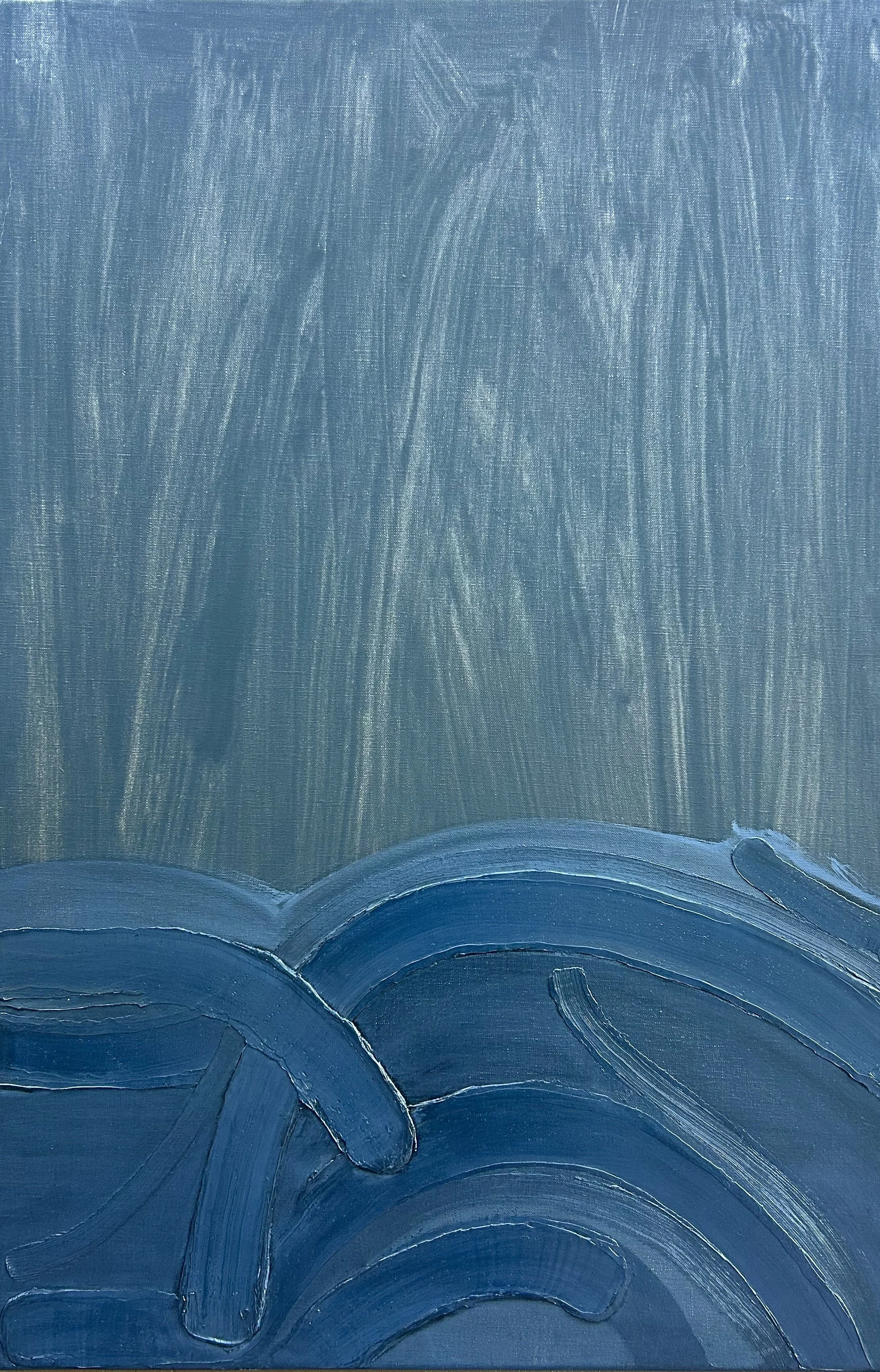
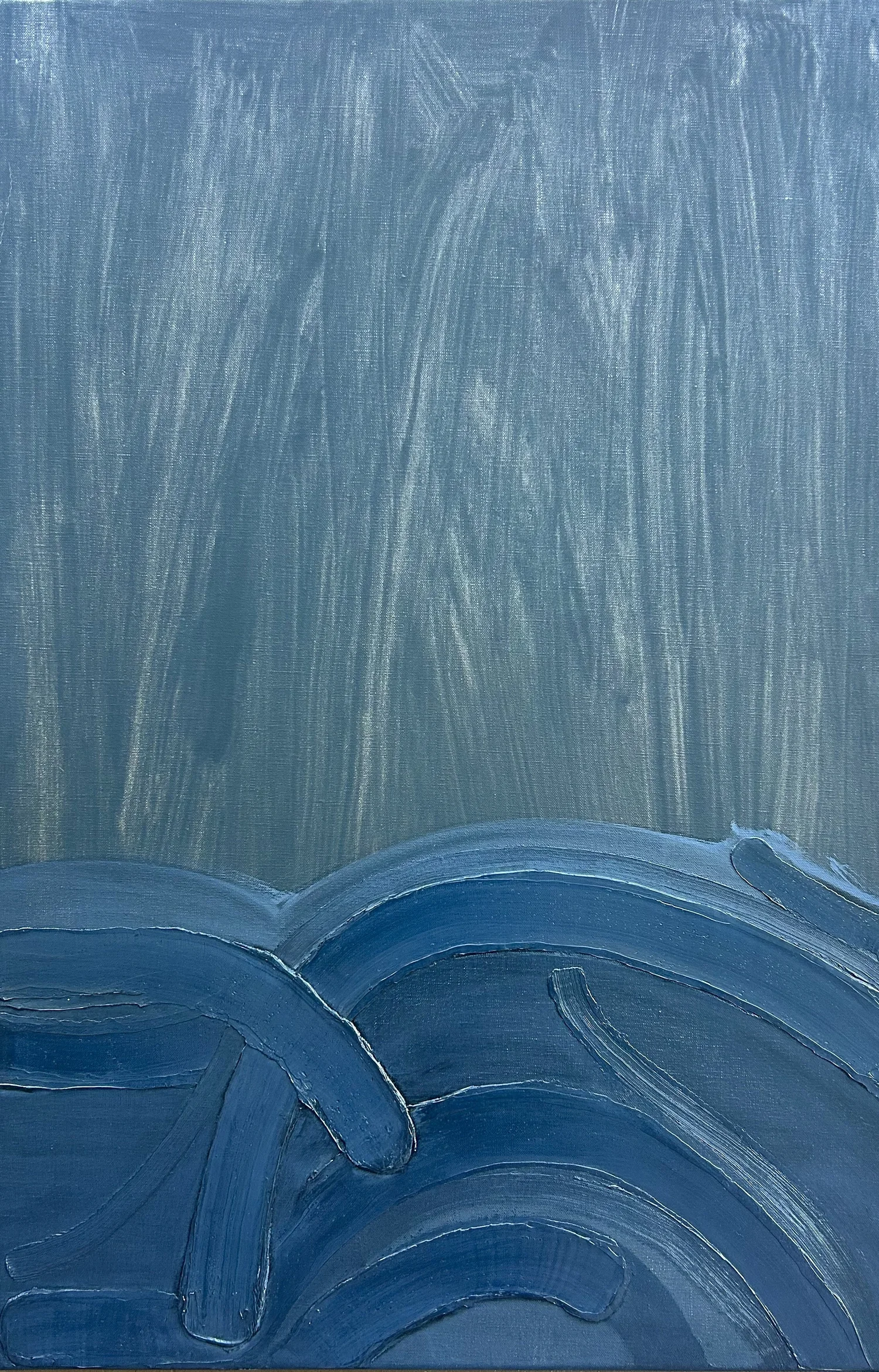
A blue field divides into two kinds of movement: fine descending traces above and broad, overlapping curves below. Fluidity finds a tangible form in the weight and texture of oil paint.
- Medium
- Oil on canvas
- Dimensions
- 91 × 64 cm
35.8 × 25.2 in · Height × width - Enquiries
- Price and current availability on request
Request pricing, provenance and condition information.
Explore the painting01 / Movement held in paint
What flows.
What remains.
A curatorial reading by G-ALLERY
Feelings Are Like Water begins with a comparison. Its title brings an unstable, inward experience into relation with a substance that moves, gathers and changes shape. The painting gives this association a material complication: the suggestion of flow is carried by paint whose ridges and edges remain visibly fixed on the canvas.
Two distinct movements occupy the surface. In the upper field, pale vertical traces pass through a muted blue, their uneven lengths and densities making the ground appear worked rather than uniform. Below, broader bands bend across one another. Their curves create an accumulation at the foot of the painting, as though a dispersed movement had gathered into a more concentrated mass.
A current without a horizon
The lower forms invite associations with waves, yet the composition does not settle into a conventional seascape. There is no distant shore, and no clear horizon separating sky from water. The upper field can suggest falling rain, a veil or simply the downward movement of a brush. The painting keeps these possibilities in circulation without supplying a single scene to organise them.
The curved bands likewise remain both image and substance. Their edges catch light as small raised boundaries; changes within the blue register the passage of the tool across wet paint. An apparent current becomes, on closer inspection, a record of contact. The work’s movement belongs as much to its making as to anything it might depict.
Feeling as a changing relation
It would be easy to assign blue a single emotional meaning. This canvas makes that reading insufficient. Its upper register is relatively open and dispersed, while the lower register is heavier and more insistent. Calm and pressure can coexist, with neither becoming the definitive mood of the whole.
Read against a contemporary tendency to name and communicate feelings through immediately recognisable signals, the painting offers a less categorical language. Its emotional character arises between different speeds, densities and directions. The title’s analogy remains useful precisely because water has no permanent configuration: a feeling, too, can be understood through its changes rather than reduced to a fixed label.
02 / The blue surface
Depth through
differences of touch.
The restricted palette places unusual emphasis on how paint is distributed. In the upper area, lighter streaks allow one blue to be read through another. Across the lower arcs, thicker applications produce more continuous, weight-bearing forms. Depth develops through these differences in handling rather than through a fully described perspective.
The junction between the two registers is especially active. A broad rise near the lower centre meets a neighbouring curve, interrupting any uninterrupted sweep from one side to the other. Each passage has its own direction and duration. Their meeting makes the lower section feel assembled from successive movements.
At 91 centimetres high, the canvas allows these marks to be encountered at a concentrated scale. Looking can move from the overall division of the field to an individual ridge, then return to the larger rhythm. The surface supports this repeated adjustment between an image of motion and the physical evidence of paint.
03 / Across the series
A motif
in changing conditions.
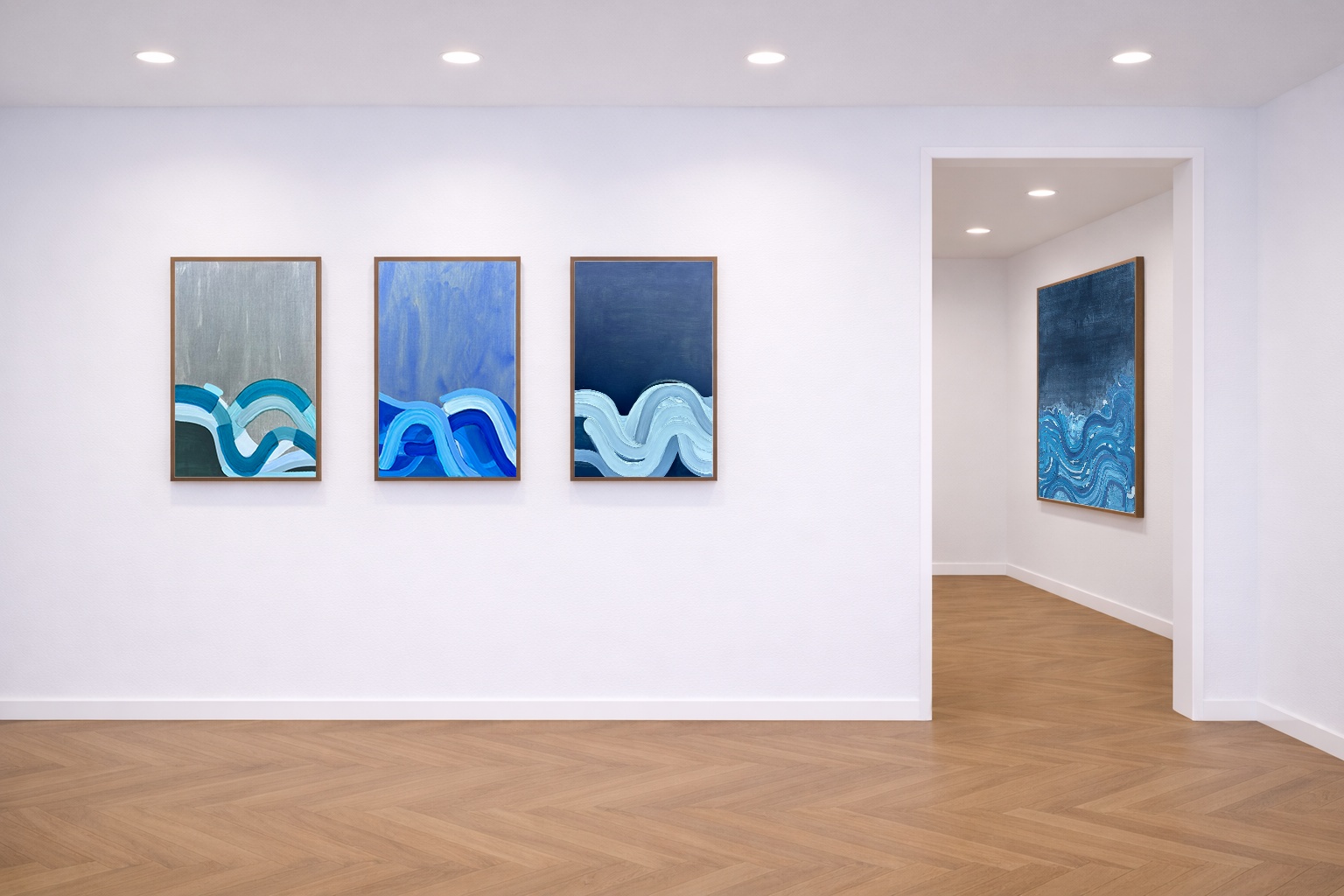
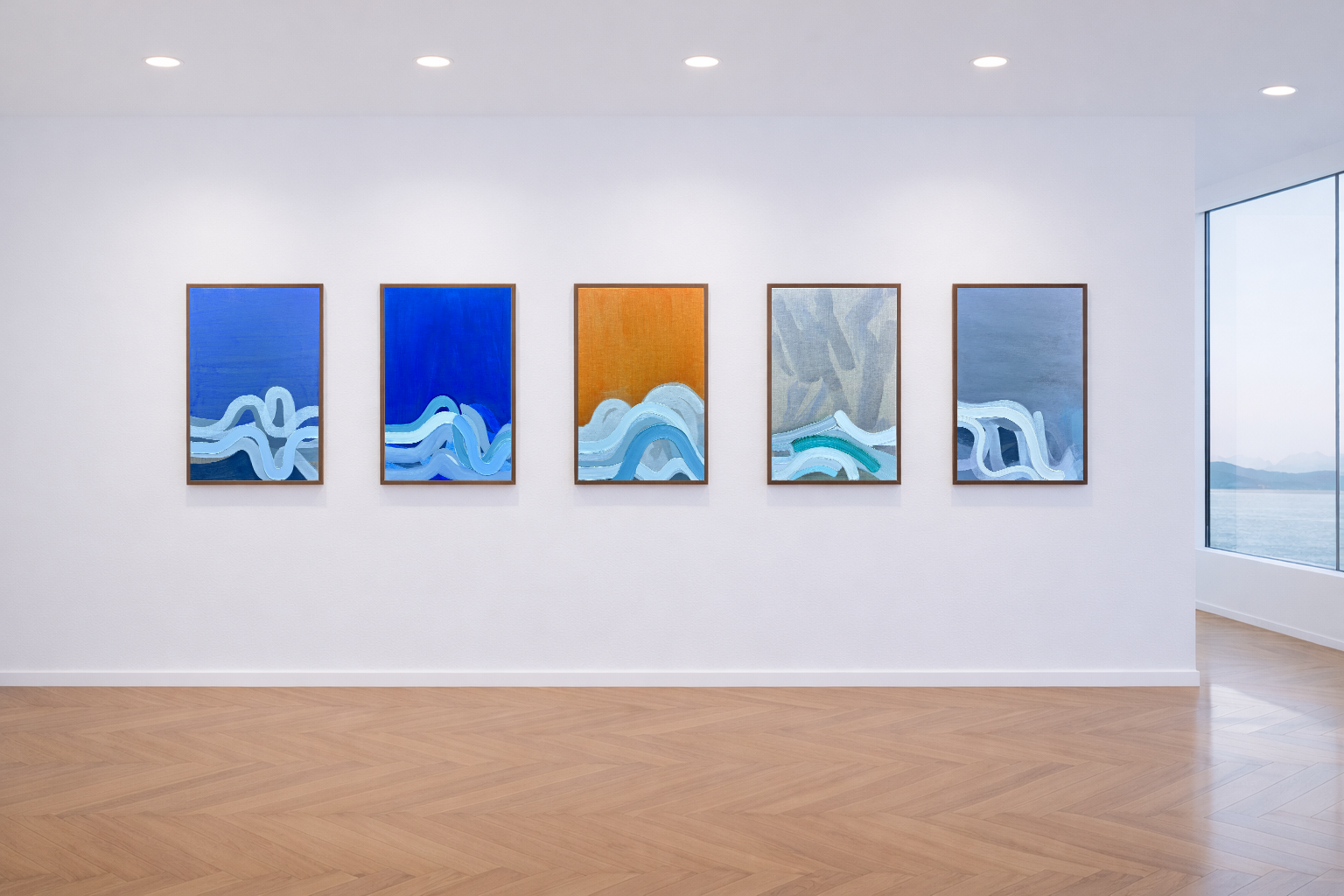
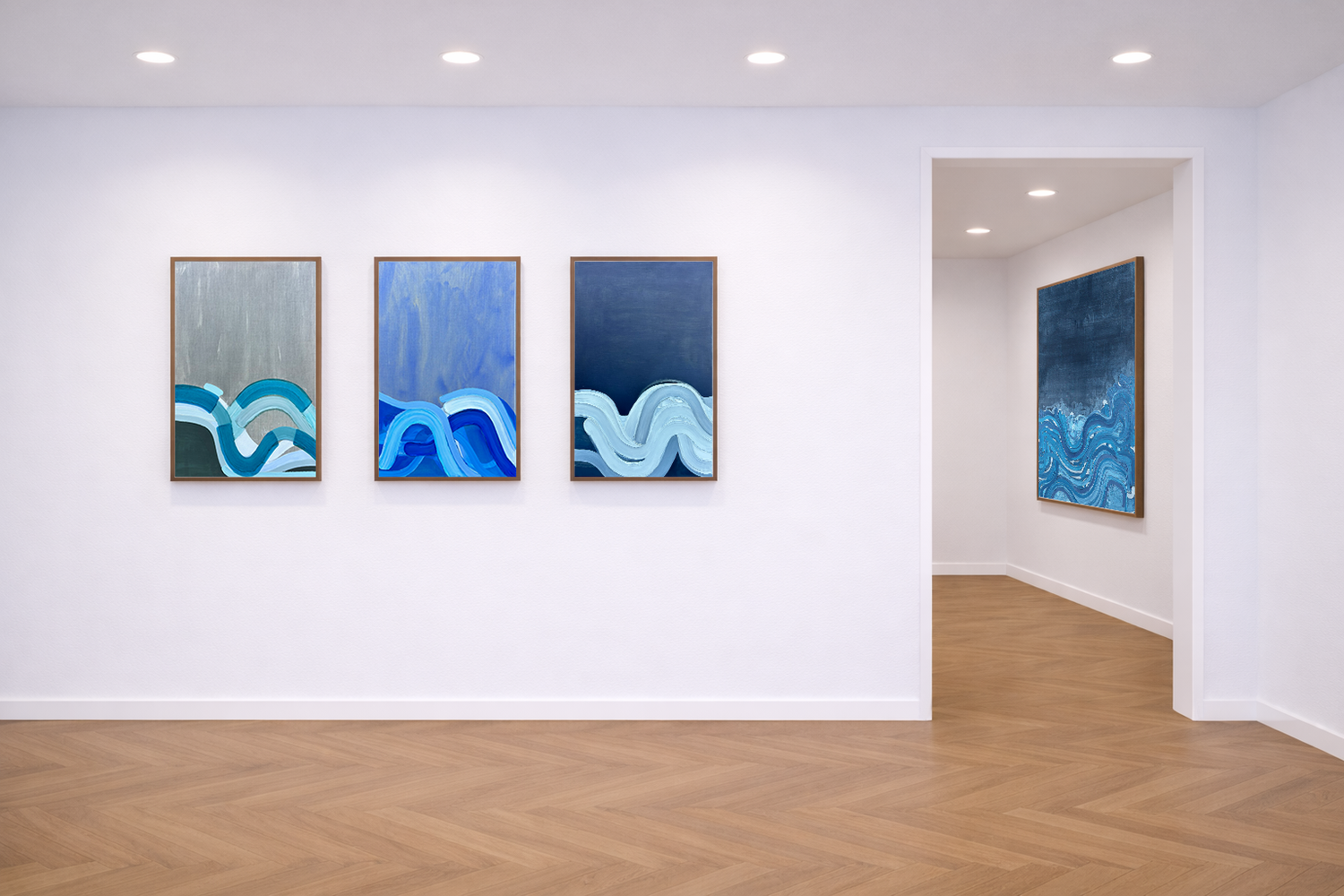
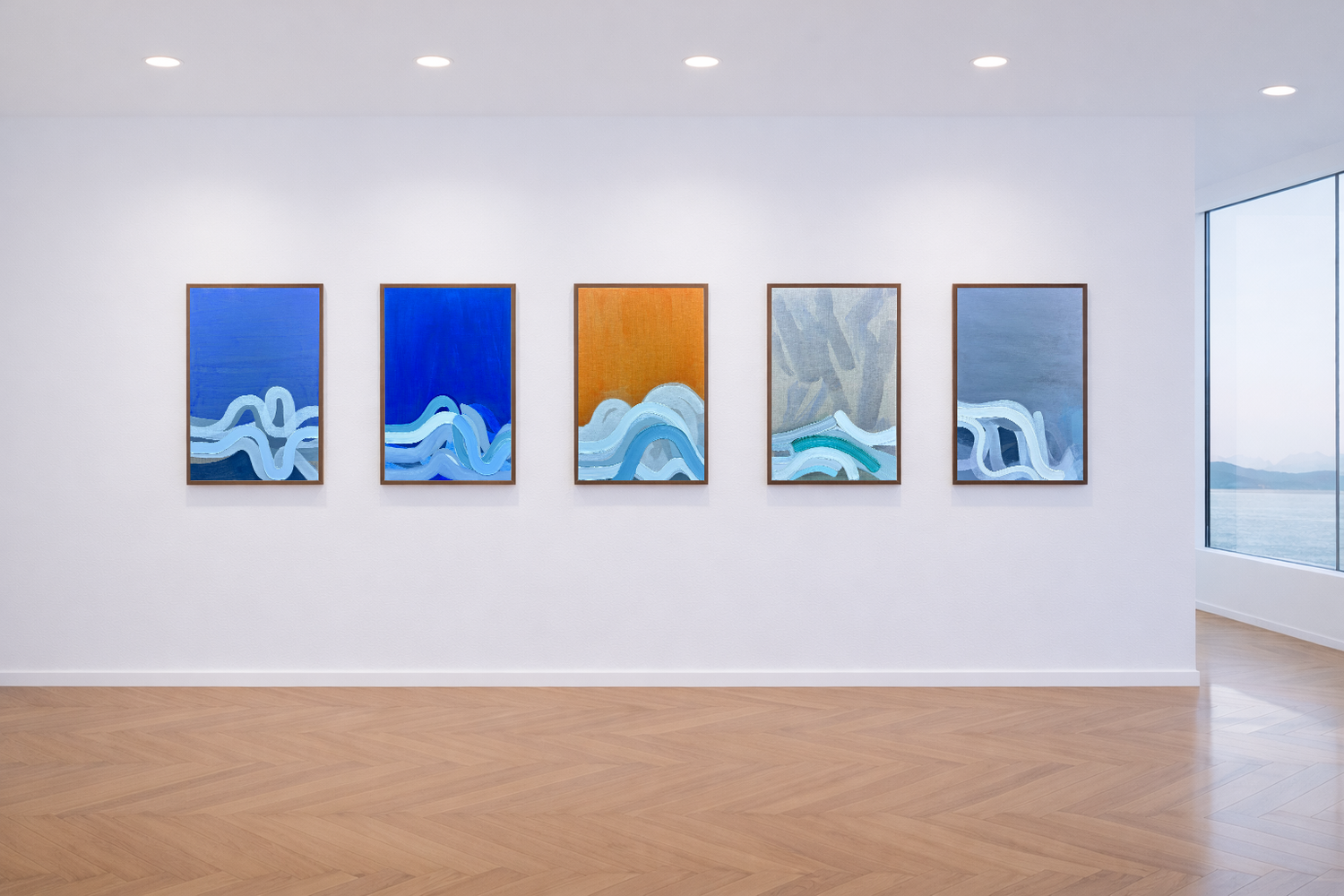
The installation brings related paintings into view together. Curving forms recur against markedly different grounds, including intense blue, warm ochre and pale grey. Their apparent temperature and weight change with each surrounding field.
Repetition therefore becomes a means of comparison. A familiar curve can seem buoyant in one colour relationship and compressed in another. The individual canvas retains its own balance, while the group makes the variability of the motif visible. The series extends the title’s proposition through difference: continuity need not imply a single, unchanging state.
04 / Collecting this work
Enquire about
Feelings Are Like Water.
Contact G-ALLERY for the price, current availability and documentation for the individual painting shown above.
Enquire about this paintingart@g-allery.com
What are the medium and dimensions?
The listed painting is oil on canvas, 91 × 64 cm (35.8 × 25.2 in), height × width.
Do the gallery views show a single work?
The gallery views present several separate paintings from the series. This page’s dimensions refer to the individual blue painting shown under “Full painting”.
How can I find out more?
Ask for the current price, provenance and condition information, or viewing options. Include your destination if you would also like to discuss delivery.
The artist / Further context
John Millei’s practice.
Explore the artist’s biography and his movement between abstraction and the figure.
Explore the artistContinue looking / Available paintings
Woman in a Chair (Pink).
A seated figure and an expansive pink ground introduce a markedly different scale of encounter.
Explore Woman in a Chair (Pink)All available paintings