
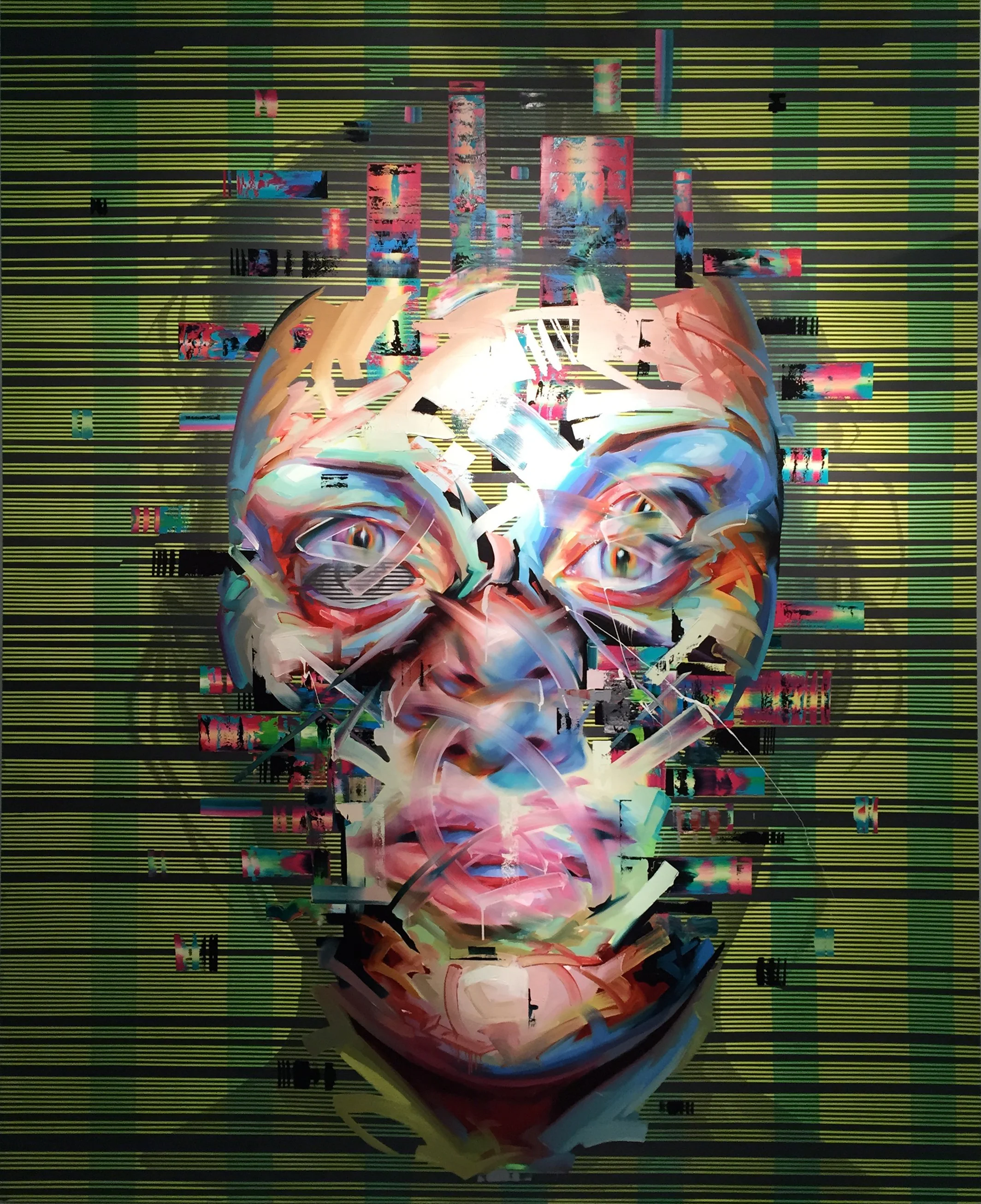
Justin Bower
Moment of Collision
oil on canvas
350 × 275 cm / 137.8 × 108.3 in (height × width)
museum exhibited


A monumental painting / Justin Bower
Justin BowerMoment of
Collision
At 3.5 metres high, a face becomes an encounter with scale. Repeated yellow-green lines set a measured pulse against the force of sweeping colour.
- Medium
- Oil on canvas
- Dimensions
- 350 × 275 cm
137.8 × 108.3 in · Height × width - Enquiries
- Contact G-ALLERY for price and availability
Request the work’s documentation and discuss the practical requirements of a painting at this scale.
Discover its visual rhythm01 / Rhythm & interruption
A measured pulse.
A sudden break.
A curatorial reading by G-ALLERY
The first organising force in Moment of Collision is its field of closely spaced horizontal lines. Yellow-green bands traverse a dark ground, establishing a rhythm that seems to continue beyond the face. Rectangular passages of pink, blue and black break into this field at irregular intervals. The painting’s movement begins in the friction between these two tempos: repetition and interruption.
The face does not simply occupy the centre of that structure. Sweeping arcs of colour redirect its lateral movement, carrying the eye around the brows, down the nose and across the mouth. Pale passages flare against saturated blues and reds. Angular fragments cut through these curves, so that a contour can become a crossing point rather than a boundary. The composition sustains its intensity by refusing to let any one direction prevail.
A collision without a single instant
The title suggests an event, but the painting distributes that event across its surface. There is no isolated point at which everything happens. Instead, encounters between lines, fragments and broad gestures recur at different scales. A small rectangular interruption can arrest the eye as sharply as a sweeping passage through the face. The viewer assembles a sequence of collisions through the act of looking.
This structure offers a way to consider attention within the contemporary image environment. On screens, a continuous stream is repeatedly broken by signals that demand a response. Here, comparable tensions are held within a stationary object. The painting supplies no sequence to follow and no moment at which the image has finished unfolding. Attention can move laterally, return to an earlier passage or pause over an unexpected interval.
Scale changes the terms of looking
At 350 × 275 cm, these visual decisions exceed the scale of a hand-held image. The dimensions make distance consequential: from farther away, the head commands the field; nearer to the canvas, individual passages occupy a greater share of vision and the whole becomes harder to retain. The work’s monumentality is therefore more than an enlargement of a portrait. It creates a negotiation between the painting’s physical extent and the viewer’s capacity to take it in.
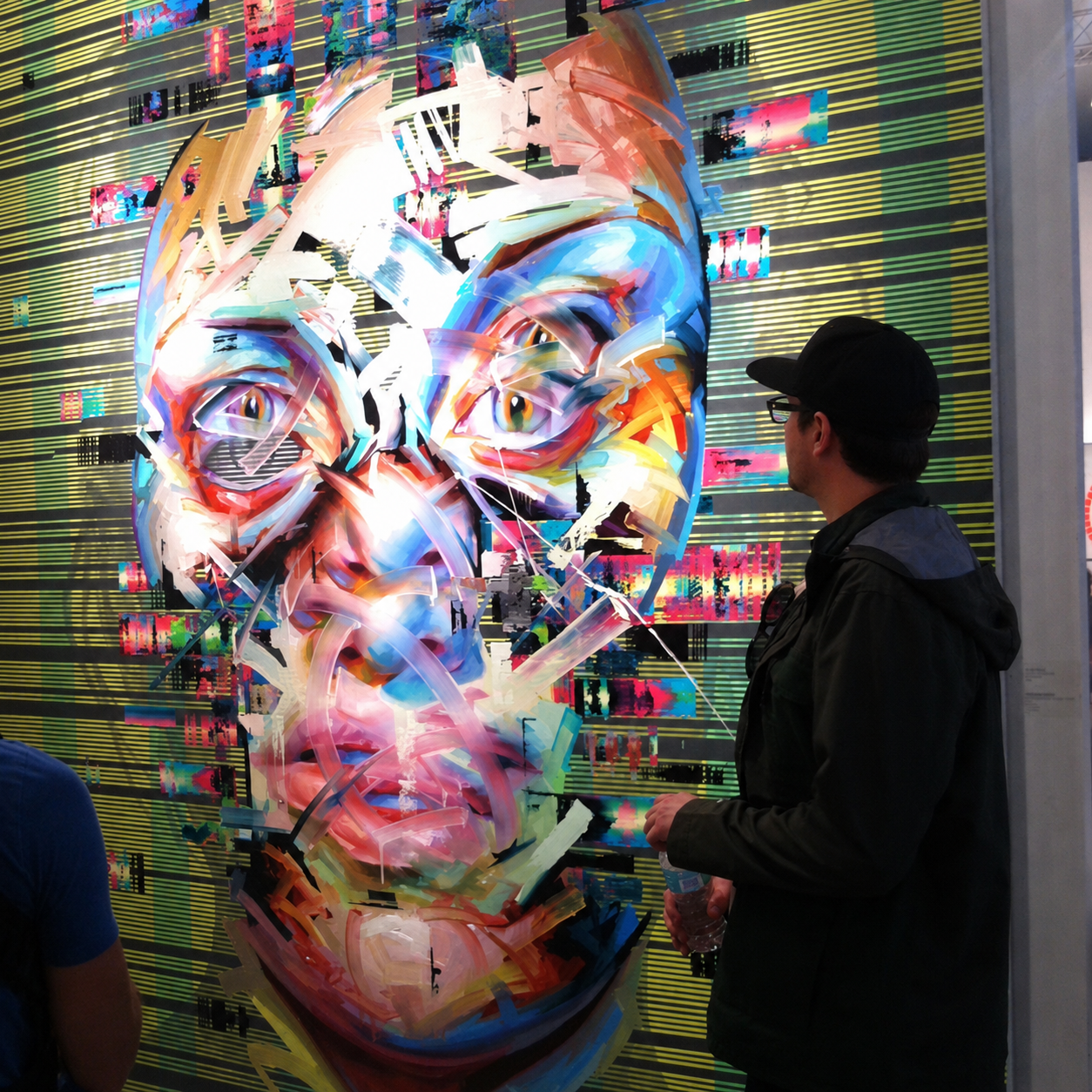
02 / The viewer & the painting
The body
as a measure.
The figure standing beside the canvas makes its dimensions tangible. The painted head extends well beyond the visitor’s own, shifting the familiar proportions of a face into an enveloping visual field.
At this distance, taking in the painting requires more than a fixed glance. Looking travels between zones: the bright forehead, the intersecting eyes, the curved passages around the mouth and the surrounding lines. The photograph gives a sense of how a viewer’s position becomes part of the encounter.
This is an exhibition photograph, included as a record of scale and viewing proximity.
03 / In the exhibition space
One painting.
A different room.
Seen among other paintings, Moment of Collision establishes a pronounced vertical emphasis. Its dense yellow-green field holds the centre of the installation, while the surrounding white wall gives the composition room to register as a whole.
The wider photograph also shows why a painting of this size benefits from more than a close viewing position. Open floor space allows a visitor to move between the overall composition and the more local encounters described above.
Exhibition documentation from the gallery’s image archive. The photograph is shown in its full composition.

04 / Acquisition & placement
Considering
a work of this scale.
A painting measuring 350 × 275 cm calls for a conversation about both the work and the space it will occupy. G-ALLERY can confirm its current availability and discuss the information needed to assess a proposed placement.
Discuss Moment of Collisionart@g-allery.com
What should I share about the intended space?
Wall dimensions, ceiling height and photographs of the room provide a useful starting point. Include access information such as doorways, stairs or lift dimensions so handling and installation requirements can be assessed.
Which records should I request?
Ask for the available condition report, provenance and exhibition documentation for this painting. The gallery will clarify the records it can provide and any further information relevant to your enquiry.
How can delivery be assessed?
Provide the destination and proposed installation setting. Packing, transport and on-site handling can then be discussed for this particular work; arrangements should be confirmed before acquisition.
The artist in conversation
Scale, perception
and the human subject.
Read Justin Bower’s conversation with G-ALLERY for a broader perspective on the questions behind his painting.
Read the conversationView Justin Bower’s profile
The next painting
Magician II.
Continue through the available works with Magician II, an oil painting measuring 180 × 152 cm.
Explore Magician IIReturn to available paintings
