
John Millei: Woman in a Chair Series ´26
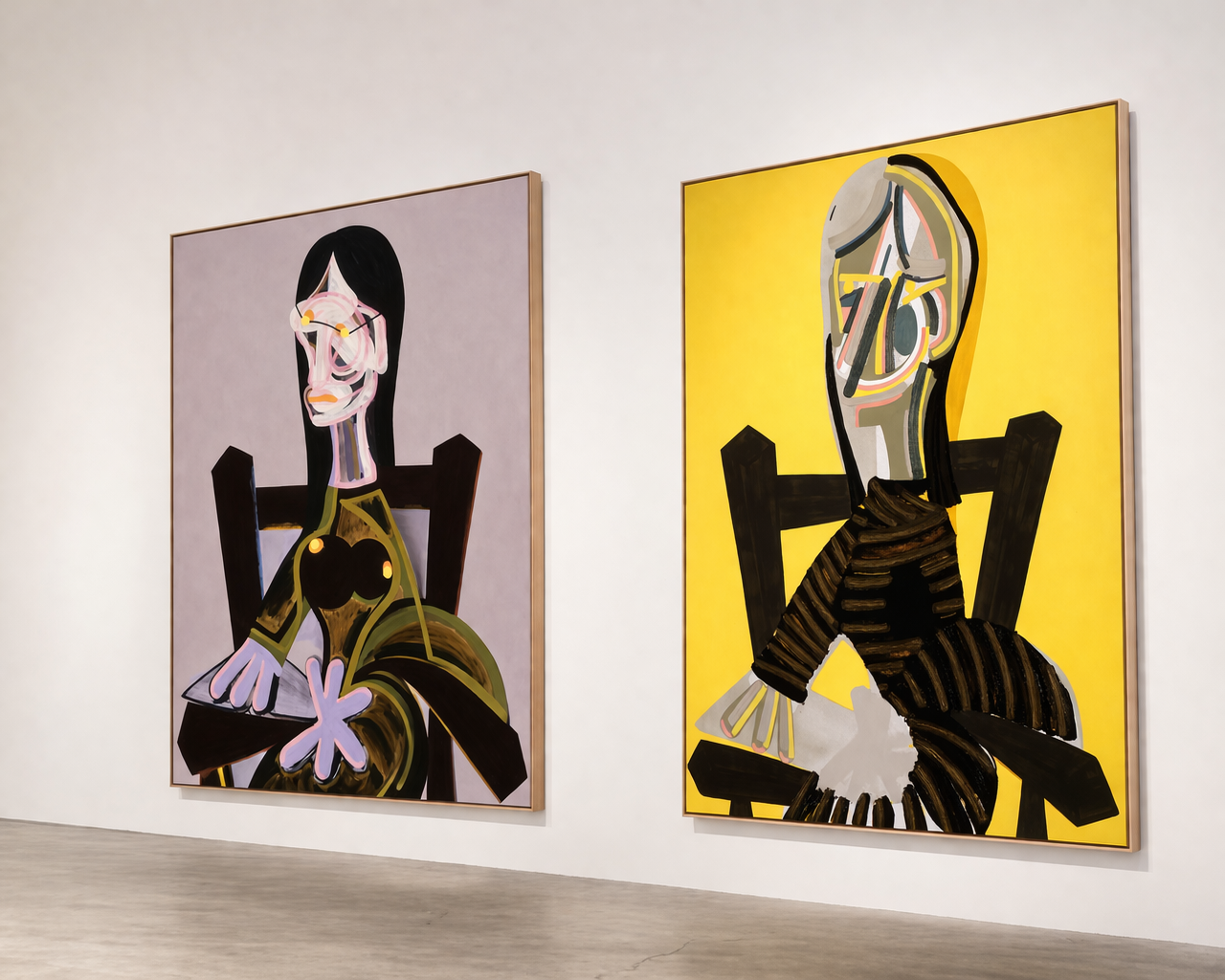
With the Woman in a Chair series, John Millei brings one of the central questions of his painting into particularly sharp focus: how can the human figure be painted today without collapsing into mere illustration, psychologisation, or citation? Born in Los Angeles in 1958, Millei began his artistic career in the late 1970s as an assistant to Richard Diebenkorn. Over the decades, he developed a visual language that moves deliberately between abstraction and figuration, art-historical memory and the immediacy of painting in the present. At the same time, through his long-standing teaching appointments at ArtCenter College of Design in Pasadena and Claremont Graduate University, he has shaped several generations of younger artists.
Within the history of Los Angeles art, Millei occupies a distinctive position. His work is associated with a generation that led Californian painting away from the cool rigor of the Light and Space milieu toward a more open, embodied, and historically charged mode of painting. In this context, Millei’s practice should never be understood as a stylistic retrospective, but rather as an active engagement with the very conditions of painting itself: with form, gesture, surface, structure, and the image-memory of modernism. Critical writing on his work repeatedly underscores precisely this tension—the suspended state between image and object, between the readability of motif and painterly construction.
First presented at Ace Gallery in Beverly Hills in 2009, the Woman in a Chair series marks a particularly incisive body of work in this regard. Its point of departure is Pablo Picasso’s Portrait de femme (Dora Maar) from 1938. Yet Millei is interested neither in repeating a canonical image nor in creating a homage in any narrow sense. Rather, the iconic motif of the seated woman serves as a structural armature, a formal device that he stretches, dismantles, compresses, and reorganises through paint. Later exhibition texts likewise emphasise that this body of work is not fundamentally about Picasso or Dora Maar as subject matter, but about Millei’s own stylistic development and the question of how a historically charged image can once again become productive in the present.
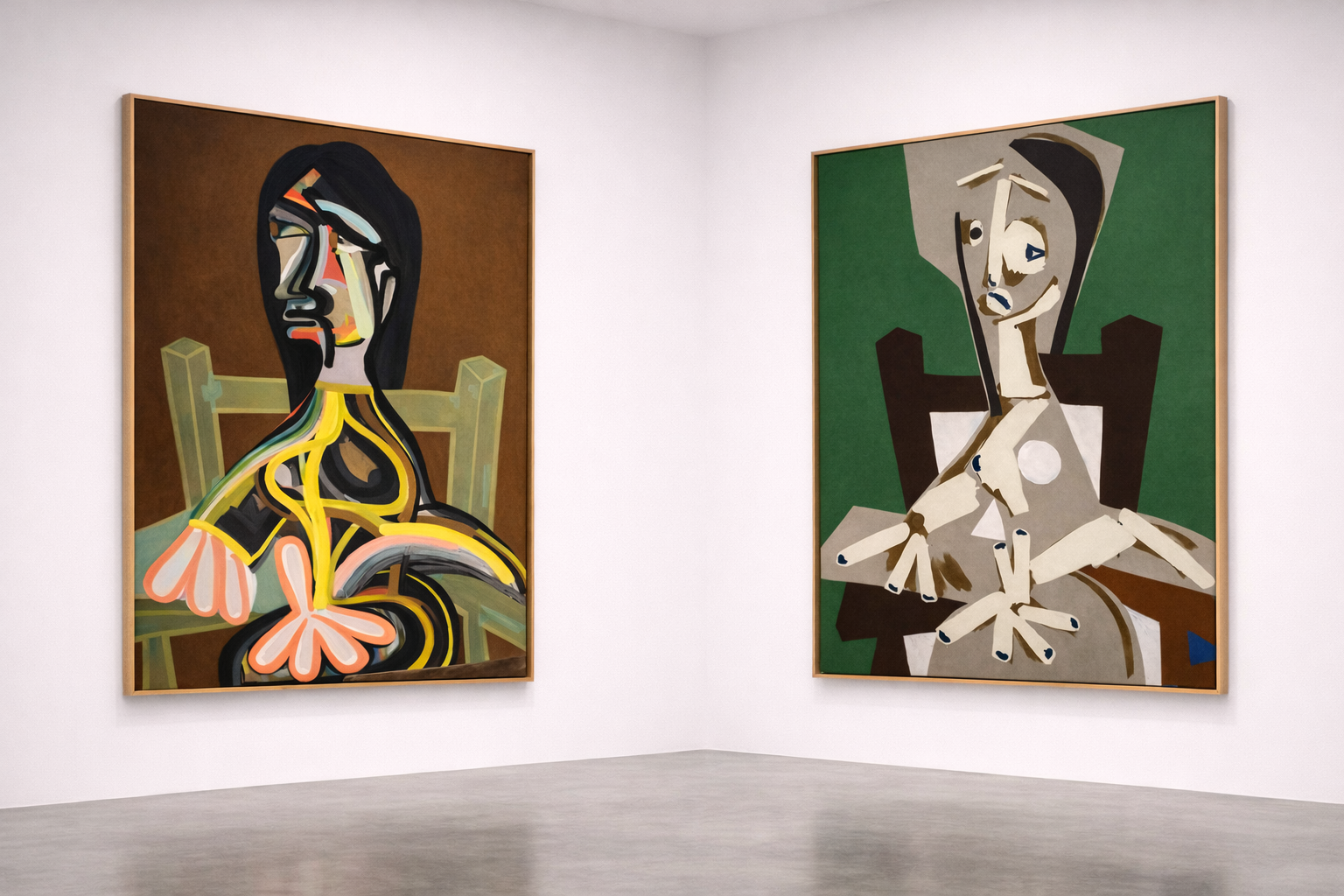
It is precisely here that the particular strength of the series lies. The underlying figure remains recognisable, yet within this given framework Millei allows himself maximum freedom. Silhouette, chair structure, hands, head, and torso-like internal forms are transformed from painting to painting: at times block-like and architectural, at others nervous, elegant, grotesque, or almost playful. Colour does not function illustratively, but as a constructive force. Lines do not simply describe contours; they carry the painting both structurally and rhythmically. One critic aptly described this work as operating in the space between imagehood and objecthood; every placement carries structural weight, and every brushstroke is an integral part of the whole. Within this reduction, an unusual tension emerges—between control, precision, and painterly freedom.
Millei’s own reflections on the figure are especially revealing in this context. In a conversation from 2007, he remarked that he had long avoided the figure in painting because, in the face of photography and cinema, he wanted to reconsider the role of figuration within the medium of painting. His response is not narrative depiction, but a kind of reduction: the figure is stripped down to a few essential, load-bearing elements, almost like a still life or a constructed sign. In Woman in a Chair, the human presence therefore appears not as a psychologically elaborated individual, but as a painterly event—a site where art history, perception, memory, and formal decision converge. The fact that the series was shown at Ace Gallery as a large group of 27 works, some in monumental formats, further underscores the serial and experimental character of the project.
From today’s perspective, Woman in a Chair can be read as a key series within Millei’s oeuvre. It brings together the essential constants of his painting: the productive friction between abstraction and figuration, the appropriation and transformation of art-historical precedents, the assured command of scale and surface, and the insistence on the contemporaneity of painting. It is no coincidence that Millei’s work is now held in major public collections, including LACMA, the Berkeley Art Museum, the Centre Pompidou, and the Colección Jumex. Woman in a Chair makes clear why his painting has maintained such a singular position for decades: it uses the history of art not as a burden, but as material—from which it develops images that feel at once familiar and entirely new.