
A Conversation with Justin Bower
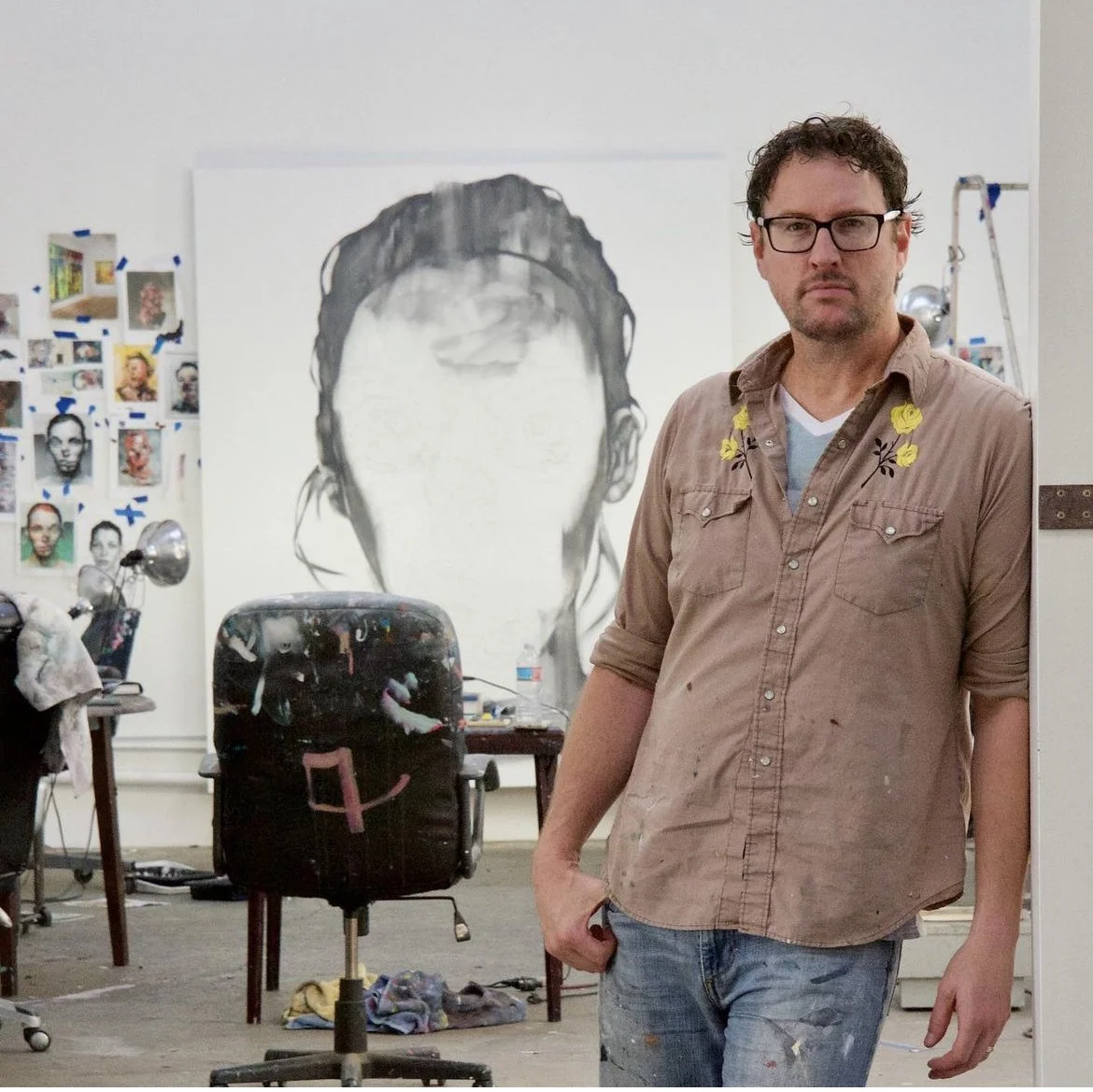
The Subject Is Already Gone
A conversation with Justin Bower on "Spaceboy and the Supercognate“
„Spaceboy and the Supercognate: A Theory of Radioactive Being“ moves through questions of instability, portraiture, glitch, cyber-capital, and the changing condition of the human subject. Rather than approaching the book through a conventional review, I wanted to press on the tensions it raises — particularly around representation, technological acceleration, and what remains of the subject under conditions of continuous transformation. “Spaceboy and the Supercognate” was written by Justin Bower and Grant Vetter. The following exchange developed through responses by Justin Bower.
THE SUBJECT AFTER THE SUBJECT
Your work often returns to the idea of instability of the subject. Are you still interested in speaking about the “subject”, or are we using a term that no longer really describes what is happening?
Bower: The subject still feels like an important point of departure for me, especially if we’re studying the destabilization of the psyche under cyber-capital. While I agree that the term may be outdated because the deterritorialization of the subject is now so complete, Deleuze’s conceptualization of the subject becoming a subjectum feels more appropriate. After all, it is the idea of the subject-as-substance that is being reconfigured on a global scale by technoscience, the biotech industry, and related systems.
In dialogues around contemporary painting and technology, I have used a series of haptic effects to describe what is happening to techno-homo through the conscription of the psyche and the reconfiguration of organic relationships via social media and related infrastructures. When it comes to thinking about the subject, we might say that the modern subject and the postmodern subjectum have become a substrate that can be reconfigured through gene therapy, CRISPR, and other forms of intervention. The notion of the subject becoming substrate — or substratum — within trans/posthuman intersectionality is at the core of the book. Not incidentally, “substrate” is also a painter’s term. The book includes an appendix that addresses sixteen separate categories of destabilization and what it means for the subject to depart from an evolutionary nomos, which I think speaks directly to your question concerning what is actually left of “the subject”.
THE LIMITS OF REPRESENTATION
Your work insists on the destabilization of the subject, but still operates through representation — especially portraiture. Do you see a limit there? At what point does representation become insufficient?
Bower: Every decision I make on the canvas involves limitations regarding the breadth and depth of the gestures edited down to produce an image. Whether it’s painting, writing, a book, or even everyday conversation, limitation is simply a condition of representation. I see limits in my own choices, but no real limit to the depth of associations, connections, and derivations representational art can evoke. I often think through Harold Bloom’s theory of revisionary ratios — the idea that every artist negotiates inherited structures while attempting to chart a singular trajectory. While this perspective may feel overly utopian for a painting practice concerned with coherence, chaos, complexity, and posthumanism, I still see painting as virtually unlimited.
A kind of “productive insufficiency” may be fundamental to representational art, simply because any true image of totality remains impossible. My work moves along a trajectory tied to the destruction of the subject as it falls back into abstraction — but also to the possibility that this collapse loops back into endless cycles of rebirth and death. Perhaps what makes this historical moment unique is that human transformation is no longer retrospective. For the first time, we are watching it happen in real time.
REPRESENTING TRANSFORMATION
Many artistic practices try to represent ongoing transformation. Do you think it is still possible to represent it, or are we already inside a condition that requires different forms?
Bower: I believe both positions can be true at the same time. In my own work, I try to explore the breakdown of motifs, signs, and symbols related to the figure while the very conditions of representation are themselves changing so rapidly that they become difficult to track. This is one of the reasons why Spaceboy and the Supercognate concludes by proposing contemporary portraiture as something resembling a three-body problem. Any attempt to represent transformation requires multiple forms and conceptual models to describe what is happening.
But with the emergence of techno-homo, everything appears open for renegotiation. Transformation itself may be partial, total, resisted, or rejected entirely. This complexity is part of what we might call the transhuman — or posthuman — condition. Yet with the rise of designer babies, cyborg surrogates, and genetic intervention, perhaps we should also begin speaking about proto-humanity. The preparatory conditions for technological modification — what precedes transformation — may become just as significant as transformation itself. Questions surrounding hedge-genetics, speculative bio-investment, and engineered futures already suggest a radically different way of conceiving the human subject: not as a stable entity, but as malleable substance.
HAS GLITCH BEEN ABSORBED?
When we talk about glitch, we refer to error, rupture, interference. But today the system seems to absorb everything. Does it still make sense to speak of disturbance, or has disturbance already become part of the system itself?
Bower: I believe glitch motifs have largely been absorbed into mass culture as a visual trope — one tied historically to error, signal, noise, rendering, and informational disruption. Yet in what Byung-Chul Han describes as a “society of transparency”, glitch still seems capable of generating new meanings across aesthetics, politics, philosophy, and technology. Glitch migrates. It mutates. It proliferates across different regimes of signification. Its meanings continue multiplying precisely because it moves through interstitial spaces between discourses. In that sense, glitch still retains a disruptive potential. As a metaphor for contesting societies of control, it may even be gaining renewed force. I deeply appreciate the way glitch is theorized in your work, alongside the evolving discourse developed by Michael Betancourt and the language mobilized by Rosa Menkman through The Glitch Manifesto and The Glitch Moment(um).
DISRUPTION AS STRUCTURE
In your work, glitch appears as a disruption within form. Do you see it as something to represent, or as a condition that should also affect the structure of the work itself?
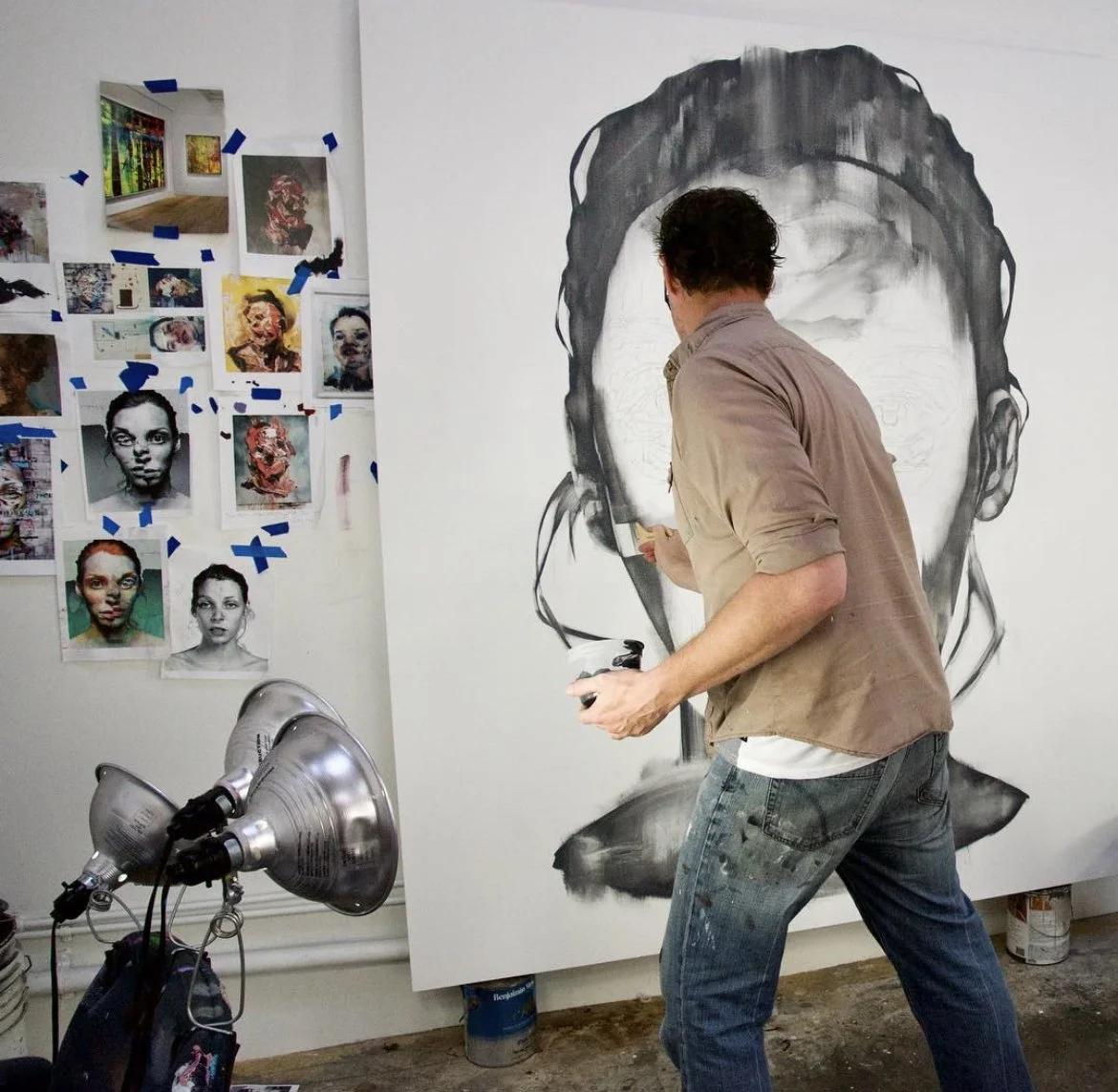
Bower: Disruption in my work has always been metonymic and performative. The distortion of features also acts as a disruption for the viewer. Organs, traces, glitches, and gestures double themselves across faces and bodies, creating a psychic disturbance that operates through scale and proximity. Because the work often functions at human scale, it can enter the psychic space of the viewer more directly. One might even say that the paintings function as mirrors for projection. The increasing disturbances produced by the transposition between the real and the virtual become part of the structure of the work itself — and, in turn, part of the complexity of what is happening to the subject.
THEORY AGAINST CHAOS
Your book builds a dense conceptual framework around instability. Do you see theory as a way to stabilize what you describe, or should it remain unstable as well?
Bower: I believe the only way forward is to enter a phenomenon as deeply as possible. Meaning, in my work, expands in multiple directions in order to understand what is becoming undone about the human subject — without ignoring what may still be worth stabilizing. I do not think of theory as a way of codifying meaning or categorizing conclusions. For me, theory operates much like painting. Another way of constructing an image of what is happening in the world. Deleuze once described theory as a means of “throwing concepts over chaos.” That phrase still describes my working method.
CLASSIFYING THE COLLAPSE
There is a strong impulse in the text to map, classify, and define. At what point does this need for structure risk neutralizing the very chaos it tries to engage?
Bower: The impulse within Spaceboy and the Supercognate to classify, define, and build theoretical taxonomies emerges from the need to create some kind of scaffolding for the overwhelming quantities of information produced within technologically accelerated life. We still have not fully confronted what it means to process more information in a day than many of our ancestors encountered across entire lifetimes. In many ways, this informational saturation may already be transforming subjectivity more profoundly than biotechnology itself. Or perhaps information has already become a primitive form of biotech. This follows Nick Land’s proposition that technology itself may be understood as artificial intelligence.
I’m less concerned with the possibility that classification neutralizes chaos than I am with the possibility that we may no longer possess the cognitive capacities necessary to keep pace with computational systems. At the very moment we are developing singularity-scale technologies, we may be reaching the limits of human processing power. Perhaps we are not building these systems solely out of a desire for innovation or progress, but because human beings increasingly lack the ability to map and classify reality at the scale contemporary existence demands. In some sense, we are still living inside the encyclopedic ambitions of the Enlightenment. The difference is that we have handed that project over to large language models. Technology appears increasingly Janus-faced. Its promises and dangers remain inseparable. What Heidegger once called the “saving power” of technology may coexist with its destructive force. And perhaps this is why I no longer worry too much about neutralizing chaos. We may already be confronting something far larger: the instability of the conditions through which humanity understands itself.
IRREVERSIBLE LOSS
The relationship between technology and identity is often described as transformation. But transformation still implies continuity. Is there something that, in your view, has already been irreversibly lost?
Bower: I have often created works that engage directly with the idea of irreversible loss. Art history frequently becomes my point of departure. A genuflecting figure. Baroque atmospheres. Fragments of symbolic iconography associated with what I describe as the “Dawn of New Wo/Man”. These elements create collisions between historical memory and speculative futures. My paintings are less about transformation than transfiguration. Or what I sometimes describe as transmogrification. Loss also appears structurally within the work itself. Visual information disappears from one image only to reappear elsewhere — in another series, another gesture, another motif. In that sense, a kind of meta-glitch unfolds across the practice. Something drops out. Something returns altered.
THE UNCANNY EVENT
Is there something you feel you still haven’t been able to express in your work? A limit, a tension, or a direction that has not yet found its form?
Bower: Perhaps the desire to capture a truly uncanny event. The uncanny has always existed in relation to the strange, the eerie, the inexplicable, and the almost supernatural. Yet Masahiro Mori’s concept of the uncanny valley introduced another dimension: the unsettling tension produced when something appears almost human, but not fully. Human-like robots. Synthetic beings. Cyborg presences. Something recognizably human that nonetheless remains “off”. In many ways, my practice continues to grapple with this unresolved discrepancy. The cybernetic imaginary still seems incapable of fully resolving the gap between human presence and simulated humanness. There is always a remainder. Perhaps this unresolved remainder is the limit my work continues to confront.
AFTER THE HUMAN SUBJECT
If we take seriously the idea that the human subject is no longer stable, what kind of artistic practice could actually exist within that condition today?
Bower: For as long as I’ve been painting, the academy has repeatedly announced two deaths: the death of man and the death of painting. Yet somehow, both remain with us. The human subject still occupies the center of anthropocentric experience — but perhaps only provisionally. For how much longer, I cannot say. What seems increasingly necessary is the use of every available medium to address this condition. Machine-learning. Machine-thinking. Machine-writing. All of these developments are already reshaping how creativity and critique are imagined.
Yet I also sense another horizon inside your question. A more radical possibility concerning resistance itself. How artistic practice might respond to these transformations rather than simply document them. That concern sits at the center of both my artistic practice and Spaceboy and the Supercognate. I often return to Hamlet: “To be, or not to be.” Perhaps this question now haunts the posthuman condition differently. The issue is no longer simply whether we exist. But whether we will continue to become. And whether the very idea of a stable human trajectory — an evolutionary nomos — still makes sense at all.
Conducted by Matteo Campulla, writer and researcher known for his work on Glitch Art.