
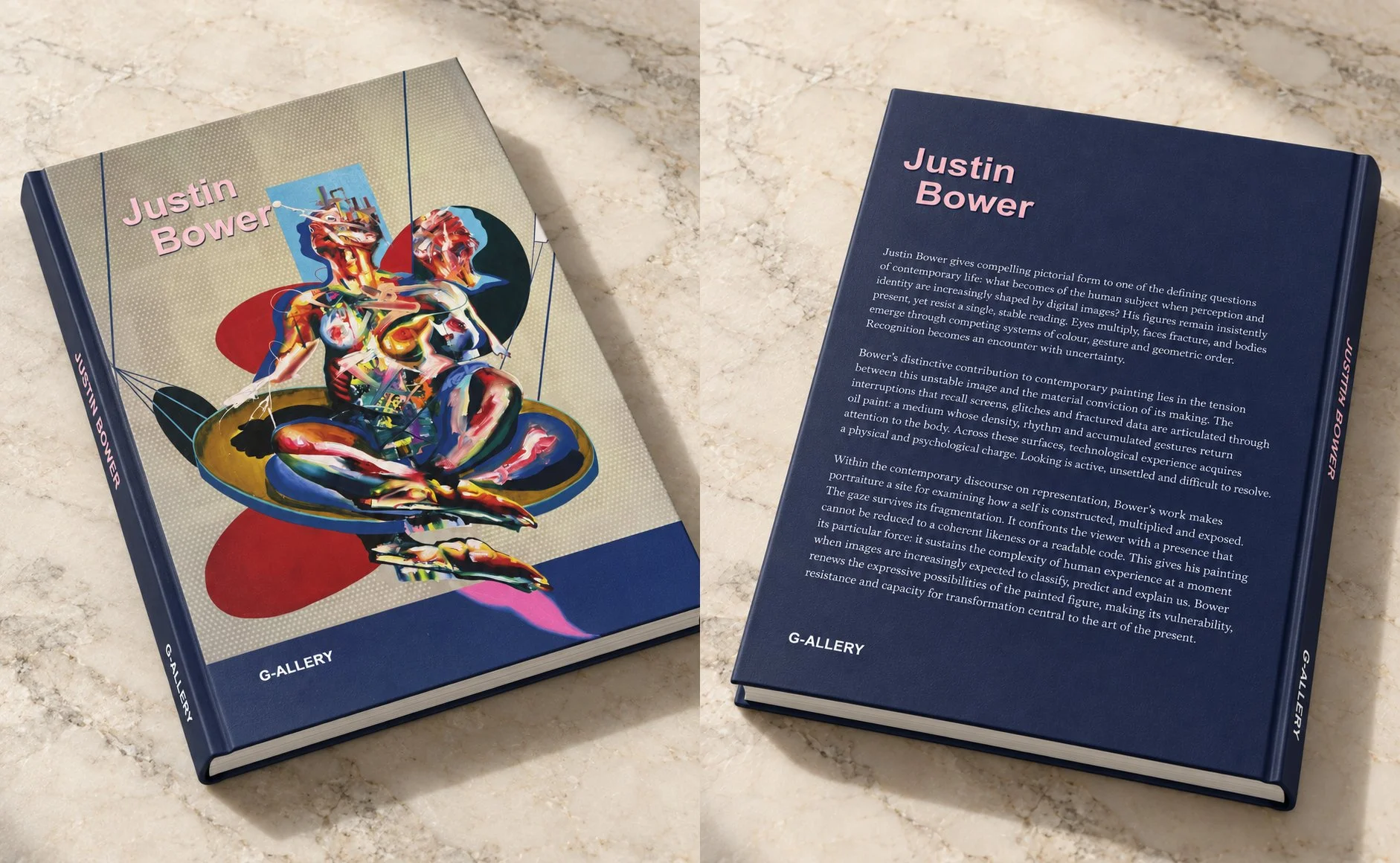
Paintings, details, studio views and critical perspectives. G-ALLERY’s new catalogue explores Justin Bower’s work and the questions of identity, perception and representation that animate it. A face is often the first thing we recognize in a painting by Justin Bower. It is also where recognition begins to falter. Eyes multiply, contours shift and passages of colour interrupt the continuity of a body. We identify a human presence, yet cannot settle on a single, coherent image of it. The longer we look, the more complicated the act of seeing becomes.
Published by G-ALLERY in 2026, The Unstable Image brings this experience into an 80-page catalogue. Selected paintings appear alongside detail photographs, studio views, critical essays and a conversation with the artist. Together, they examine a practice concerned with how the human figure can be pictured when the conditions of human experience are themselves changing. The title names something that happens within the paintings. Bower’s figures remain recognisable as their structures divide and reassemble. A painted eye establishes contact, only for its repetition to redirect our attention. Geometric patterns suggest order, while the body appears to occupy several positions within it. These competing signals draw the viewer between the figure as a whole and the individual decisions through which it has been constructed.
Such images resonate with a culture increasingly shaped by digital mediation. Faces circulate as photographs, profiles and data; identity is continually presented, interpreted and revised. Bower gives these conditions a physical form in oil paint, bringing technological experience into contact with the weight, resistance and accumulated gestures of a painted surface. The catalogue develops these relationships through changes of distance. Complete works reveal the organisation of a composition: the placement of a figure, its surrounding field, the pressure of a diagonal. Details disclose smaller events. A dragged stroke or an exposed passage of canvas can transform our understanding of an image that initially seemed almost electronic. Returning to the complete painting, we recognise something of the material work that sustains its apparent instability. Studio photographs place the paintings among brushes, containers and unfinished works. The proximity of a monumental face to an ordinary working table makes their physical scale tangible. Views of paintings in interiors extend this perspective, showing how a work establishes relationships with architecture and alters the experience of a room. For collectors, these images suggest how Bower’s paintings unfold through distance, light and repeated encounter.
The written contributions offer several critical perspectives. Texts by Andi Campognone, G. James Daichendt, Shana Nys Dambrot, Cooper Johnson and David Pagel accompany G-ALLERY’s editorial essays, inviting readers to return to the images with different questions. A conversation conducted by Matteo Campulla introduces the artist’s own voice. Taking the forthcoming book Spaceboy and the Supercognate: A Theory of Radioactive Being, by Justin Bower and Grant Vetter, as its starting point, the interview considers the instability of the subject, the limits of representation and the possibilities of painting. Following Bower’s portrait, it moves from the artist’s physical presence to the ideas informing his practice. For readers discovering Bower, The Unstable Image offers an introduction grounded in the works themselves. For those already familiar with his paintings, it creates opportunities to compare compositions, examine surfaces and trace connections across images and texts. A detail changes a first impression; a passage of writing opens another way of looking.
An art catalogue becomes meaningful through such returns. With The Unstable Image, G-ALLERY invites a continuing engagement with Justin Bower’s paintings and their persistent question: how do we recognise ourselves in an image that refuses to remain still?