
Justin Bower x RETNA: A Singular Encounter in American Contemporary Art
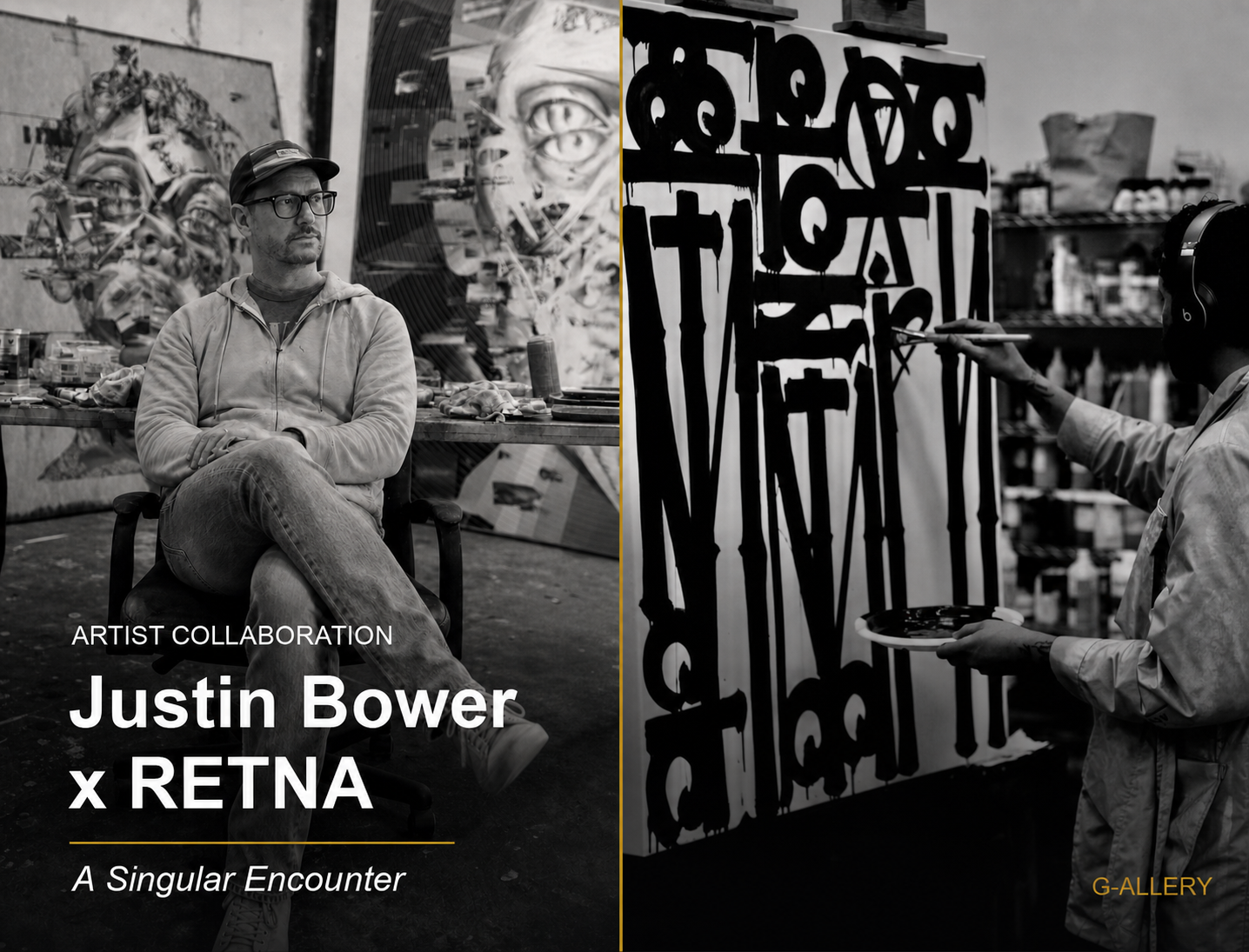
Justin Bower x RETNA brings two distinct visual systems into a sustained dialogue: Bower’s fractured portraiture and RETNA’s calligraphic architecture. The resulting paintings resist the conventions of a stylistic crossover. They are constructed as sites of encounter in which figuration, language and surface are continually reconfigured.
At the center of each composition is the human figure, unstable yet insistently present. Bower’s multiplied eyes, displaced contours and chromatic interruptions approach portraiture as a field of perceptual and psychological tension. The face is neither resolved nor dissolved; it remains suspended between physical presence and the conditions through which identity is now mediated.
RETNA’s script introduces a second order. Emerging from the writing culture of Los Angeles and developed into an autonomous pictorial language, his glyphs operate beyond conventional legibility. They establish rhythm, scale and spatial pressure—at once structural and gestural, historical in resonance yet decisively contemporary.
When these two practices meet, neither serves as ground for the other. RETNA’s black signs do not merely frame Bower’s figure, and Bower’s portrait does not function as an image beneath a graphic layer. Each language interrupts and recalibrates the other. The painting becomes less a fusion than a negotiation between two fully formed positions. This reciprocal tension is most apparent at close range. Drips, layered brushwork, saturated fields of color and shifts in texture reveal a composition built through successive decisions. From a distance, figure and script appear to form a single image; in proximity, their differences remain deliberately active.
In this sense, the collaboration connects two trajectories closely associated with contemporary art in Los Angeles: the expansion of portraiture under post-digital conditions and the movement of urban writing into the field of contemporary painting. Its significance lies not in the convergence of recognizable signatures, but in the precision with which each artist’s vocabulary is allowed to remain distinct.
No works from this collaboration are currently available for acquisition. Each painting is conceived as a private commission and developed individually in dialogue with the commissioning collector. Scale, context and the conceptual parameters of the work emerge through this exchange; there is no fixed composition or repeatable model. The commission process is coordinated privately by G-ALLERY.